






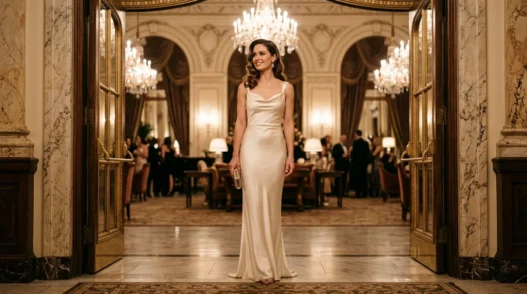
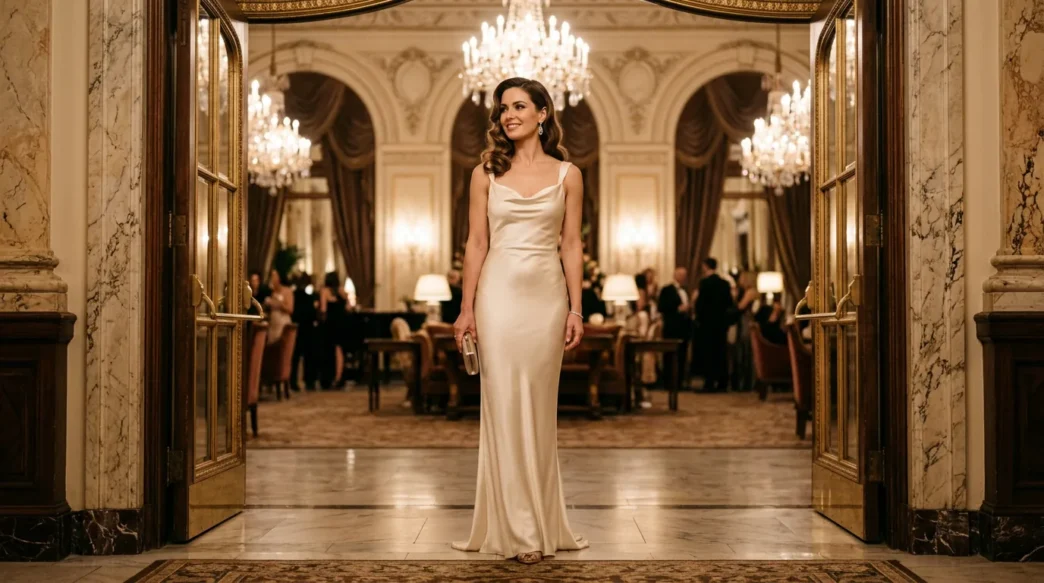
I fell headfirst into Old Hollywood style years ago because of a single photograph — Lana Turner in a cream column gown, standing in a doorway like she owned the entire building. I didn’t want to copy her. I wanted to understand the grammar of how she looked so effortlessly, precisely, correct. What I found was a rabbit hole that went much deeper than satin and structured corsets, and honestly, a lot of what I thought I knew was either oversimplified or outright wrong.
This isn’t a mood board post. I want to talk about where this aesthetic actually originates, what it costs in real money, who it genuinely flatters versus who it just photographs well on, and how you’d feel wearing a bias-cut slip in a supermarket five years from now. The glamour is real — but so is the context most people skip.
Where the Aesthetic Actually Comes From
Most people think Old Hollywood fashion is roughly synonymous with the 1930s through the 1950s — and while that’s a reasonable shorthand, it misses the political and industrial machinery that produced those looks. The studio system in its golden era dressed actresses as corporate assets. Adrian at MGM, Edith Head at Paramount, Travis Banton also at Paramount — these weren’t stylists in the modern influencer sense. They were architects whose job was to make a specific woman’s body read correctly on early film stock, under lighting conditions that were punishingly unflattering by modern standards.
Orthochromatic film, which dominated until the mid-1930s, couldn’t distinguish red from black — both photographed as dark. Costumers had to work entirely in tonal contrast, which is why so many iconic looks are built in ivory, white, silver, and black. The bias cut — championed by Madeleine Vionnet in Paris and brought to Hollywood by Adrian and his peers — wasn’t purely aesthetic. It clung to the body in a way that read beautifully in high-contrast lighting because it created its own shadow play. The visual drama was engineered, not accidental.
Then panchromatic film changed everything in the late 1930s, and suddenly color mattered in a new way. That’s when you start seeing the warmer, richer palettes in film photography — the dusty rose and deep burgundy tones we associate with late golden-era glamour. The aesthetic shift followed the technology, not the other way around. Understanding this changes how you approach the style today. You’re not just picking a dress. You’re borrowing a visual language that was built for a completely different context — which means translation is required.
The other thing worth knowing: Old Hollywood fashion was almost entirely inaccessible to anyone who wasn’t white and wealthy, at least in its mainstream presentation. Dorothy Dandridge had to fight for recognition at a time when studios refused to costume Black actresses with the same investment. Lena Horne was dressed in ways designed so her scenes could be cut from Southern screenings without disrupting the film’s continuity. The aesthetic we romanticize was gatekept by systems we should be honest about. I find that being aware of this history makes the style feel richer and more complex to engage with — not less appealing, but more three-dimensional.
When you’re building retro glamour outfits inspired by this era, you’re doing so in a completely different social context, and that’s worth acknowledging rather than glossing over with a sepia filter.
What the Silhouettes Are Really Doing to Your Body
Here’s something I wish someone had explained to me clearly at the beginning: Old Hollywood silhouettes are not universally flattering. They are specifically flattering for specific proportions — and they were built for a body type that the studio system actively enforced through contract clauses about actresses’ weights. I’m not romanticizing this. When you see a bias-cut column gown draping perfectly, that fit is optimized for a particular set of measurements, and if yours differ meaningfully, the gown tells a different story entirely.
The bias cut requires what tailors call negative ease — the fabric has to have somewhere to go when it clings to your body. This works beautifully when curves are gradual. But if you have a significant difference between your waist and hip measurements, a lot of bias-cut styles will actually emphasize the width rather than creating the smooth waterfall effect you’re imagining. Similarly, the column silhouette — Grace Kelly in her later years, Audrey Hepburn, early Katharine Hepburn — rewards a relatively straight figure. That’s not a flaw. It’s just physics and fabric.
The looks that work across a much wider range of bodies are the structured ones: nipped-waist gowns with full skirts, wide-shoulder jackets over tapered trousers, wrap silhouettes. These were the everyday-wear equivalents of the screen-ready gowns. Think Joan Crawford’s wide-shouldered suits rather than Jean Harlow’s satin columns. Crawford’s signature shoulder actually created the illusion of a smaller waist by broadening the upper body — it’s the same optical logic behind today’s power blazers, just more dramatic.
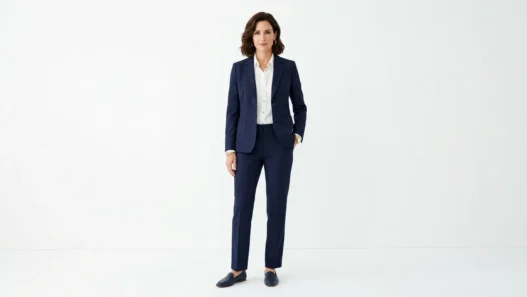
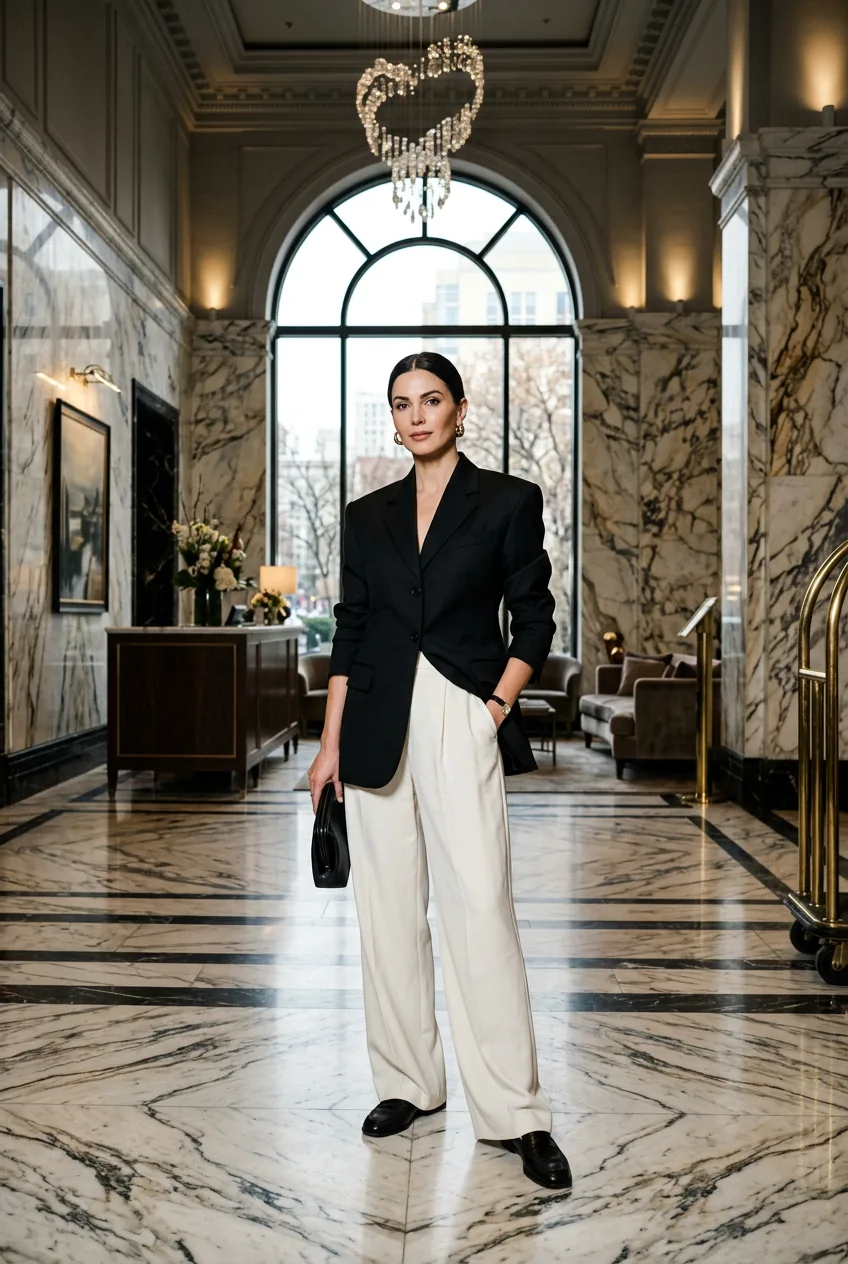
Look at the woman in the photo here — she’s wearing a wide-shoulder jacket over wide-leg trousers, and notice how the proportions work. The shoulder creates authority at the top, the trouser adds drama at the bottom, and the waist gets defined without anything pulling or straining. That’s the magic of structured Old Hollywood silhouettes done right. No one’s fighting the fabric.
If you’re drawn to the evening gown territory, I’d also point you toward sophisticated evening looks that borrow the language of this era without requiring you to commit to full period accuracy. The vocabulary of Old Hollywood — deep necklines, structured bodices, trailing fabric — translates well into modern cuts that don’t demand a stylist and a lighting director to pull off.
See the Bias Cut in Motion
The Pricing Reality Nobody Posts
Let me be direct about money, because the Instagram version of Old Hollywood style is financially misleading in a way that genuinely bothers me. The photographs you’re seeing — the ones with thousands of saves — are shot in gowns that either cost thousands of dollars or are samples pulled from designers for editorial purposes. They are not the vintage finds at thrift stores that the captions sometimes imply.
Authentic vintage from the 1930s–1950s, in wearable condition? You’re typically looking at $300 on the very low end for a damaged or heavily altered piece, and $800–$3,000+ for anything with genuine provenance, intact structure, and a recognizable construction technique. Museum-quality pieces go into the tens of thousands. I know this because I have spent considerable time at estate auctions and vintage dealers trying to find the real thing, and I have been humbled by price tags more than once.
Contemporary reproductions are your actual realistic option, and they range from genuinely excellent to catastrophically bad depending on the brand. The difference between a $90 bias-cut satin slip dress from a fast fashion retailer and a $450 version from a small atelier is not primarily the fabric — it’s the cut geometry. Bias cutting is enormously skill-intensive. You can tell immediately when a brand hasn’t invested in that skill because the fabric bunches, pulls sideways, or hangs as a sad diagonal instead of a clean waterfall.
Brands worth investigating — though I’d encourage you to do your own research and read about assessing vintage garment quality before committing to anything — tend to be smaller labels with a specific focus on heritage construction. House of CB has done some reasonable interpretations. Reformation has a few silhouettes that hit the mark. But my actual best advice is to find a good local tailor and bring them fabric swatches. A skilled tailor making a custom bias-cut column gown from quality crepe costs less than you’d think and fits better than anything off a rack.
Also worth considering: the accessories budget is often the silent killer of this aesthetic. Vintage-appropriate gloves, real or convincing costume jewelry in the right scale, appropriate shoes with period-correct heel heights — these add up fast. A single pair of d’Orsay heels in good leather starts at $200 from any brand worth buying. Budget for the full look, not just the dress.
What Changes Between Your First Attempt and Your Fifth
My first attempt at a full Old Hollywood look involved a satin slip dress, red lipstick I’d bought specifically for the occasion, pin-curled hair that took two hours and looked spectacular in the mirror, and heels I hadn’t broken in. By the time I arrived at the event, the satin had developed a stress crease across my hips from sitting in the car, the lipstick had migrated, and I’d walked exactly forty meters in the heels before deciding they were instruments of punishment.
Here’s what the fifth attempt looked like — not because I’m listing steps, but because the contrast matters. I’d learned that satin creases if you’re not strategic about sitting positions (lean back, don’t fold at the hip). I’d learned that the lip stain under lipstick is not optional if you’re trying to last a six-hour evening. I’d learned to break shoes in over several weeks and to choose heel heights that let me walk normally rather than performing the walk I thought was appropriate for the aesthetic.
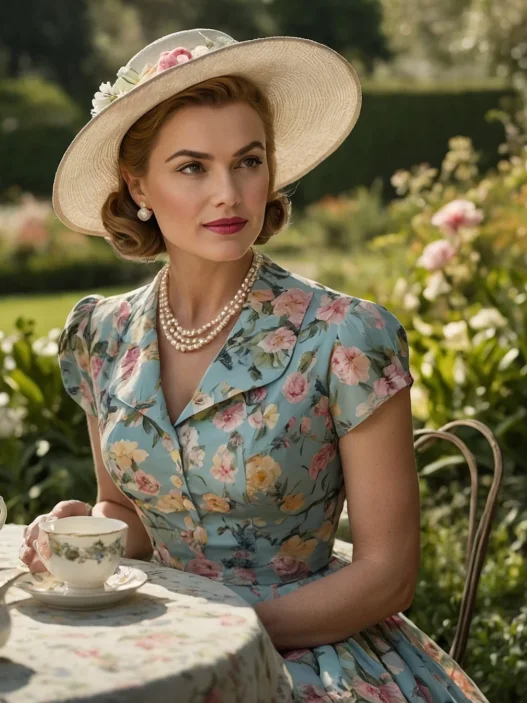
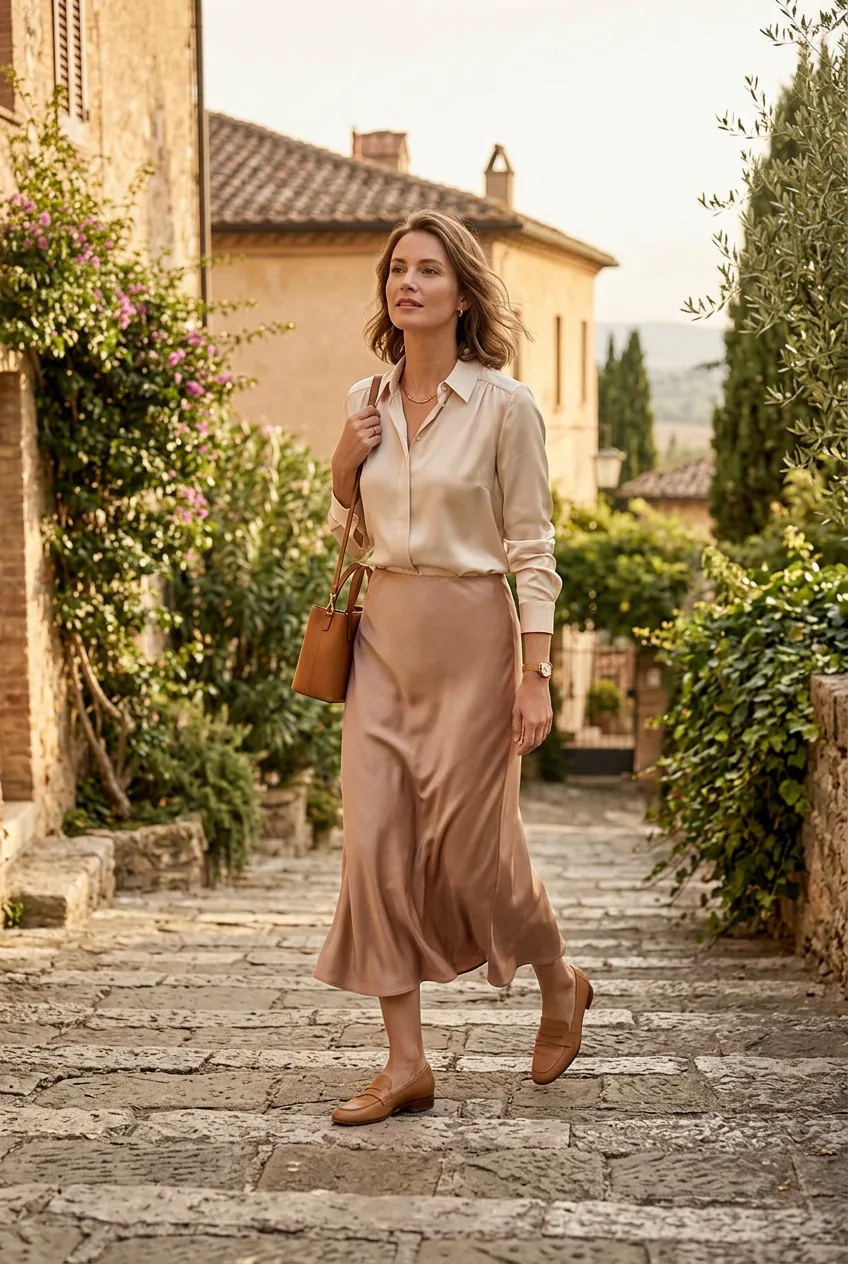
More importantly, I’d learned to drop what didn’t work for my specific life. I love the idea of full-length column gowns, but I live in a city with a lot of stairs, cobblestones, and public transit. A tea-length bias-cut skirt with a silk blouse gets me 80% of the visual language with 100% more practical functionality. You can find gorgeous vintage tea party outfits that capture the refinement of Old Hollywood without requiring a car service and a personal assistant.
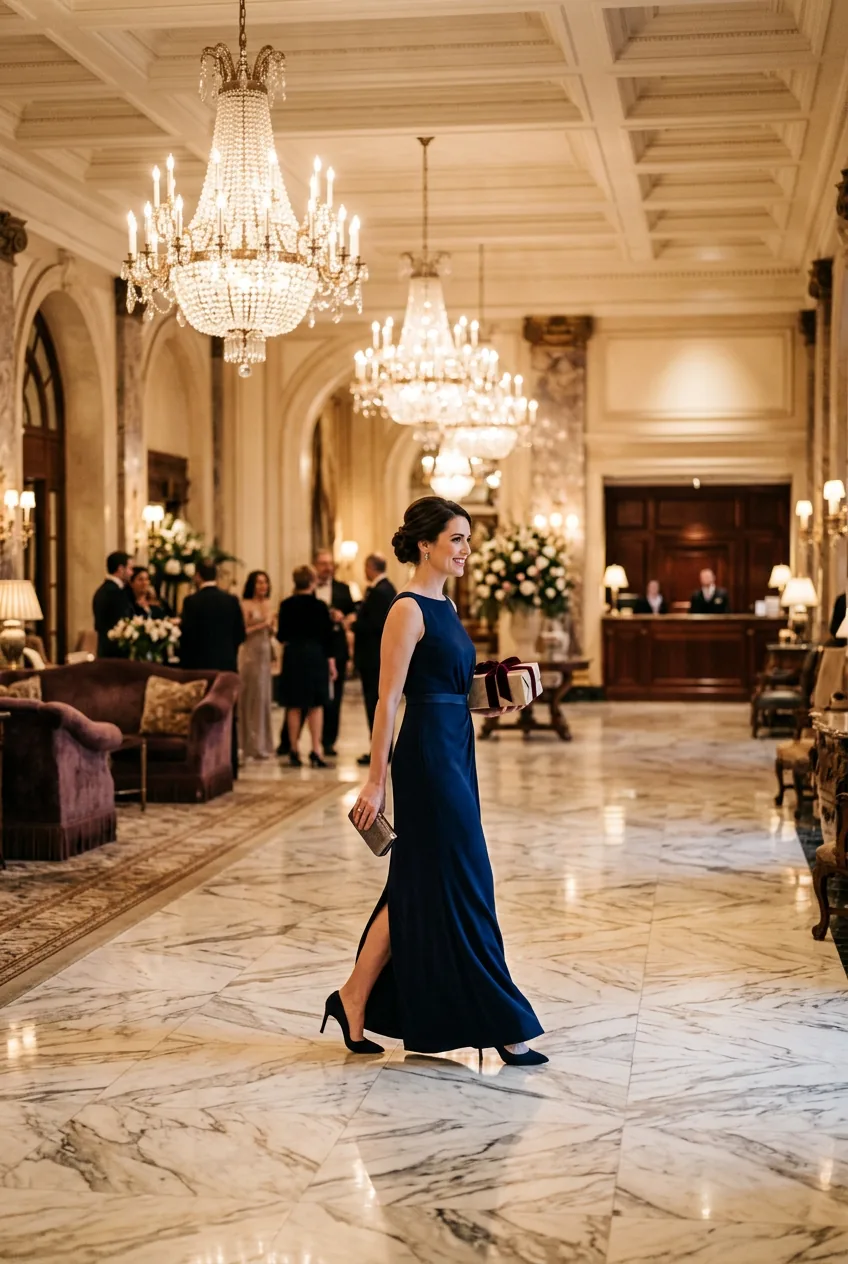
The other thing that changes is your relationship with the styling details. Early on, you try to do everything at once — the hair, the lip, the lashes, the gloves, the jewelry, the shoes with the exact right heel height. It’s overwhelming and you end up looking costumed rather than styled. By attempt five, you know which two or three elements carry the most visual weight for your specific face and figure, and you invest in those while letting the others recede. For me, it’s always been the lip and the silhouette. Everything else is supporting cast.
Understanding vintage-inspired outfit styling at a technical level — fabric behavior, construction differences, how to match modern undergarments to vintage silhouettes — is honestly what separates a convincing look from a Halloween-adjacent one.
Who Wears This Best — and the Uncomfortable Answer
This is where I’ll say something that might be slightly controversial in contemporary fashion discourse: Old Hollywood style, as a complete head-to-toe aesthetic, is genuinely more demanding than most other vintage revivals. Not because of body type — I want to be clear about that — but because of deportment, commitment, and comfort with formality. The aesthetic rewards women who are at ease with being looked at. And that’s a specific psychological state, not a physical one.
What I mean is this: a bias-cut gown on someone who’s self-conscious about it reads differently than the same gown on someone who’s claimed it completely. The poses in those famous film stills — the way Ava Gardner or Rita Hayworth occupied their own bodies — were the product of years of training and a very specific professional context. We’re not film stars. We’re regular people in gowns. The gap between those two states is bridged by genuine comfort, not by trying harder or standing straighter.
Women who tend to wear this aesthetic most convincingly in real life, in my observation? They’re usually women who already have a strong personal style and are borrowing from Old Hollywood deliberately, selectively. They’re not trying to transform into a character. They’re integrating specific elements — the structured shoulder, the column line, the red lip — into a wardrobe that’s already coherent and confident. The aesthetic works as an add-on to existing self-possession. It struggles as a substitute for it.
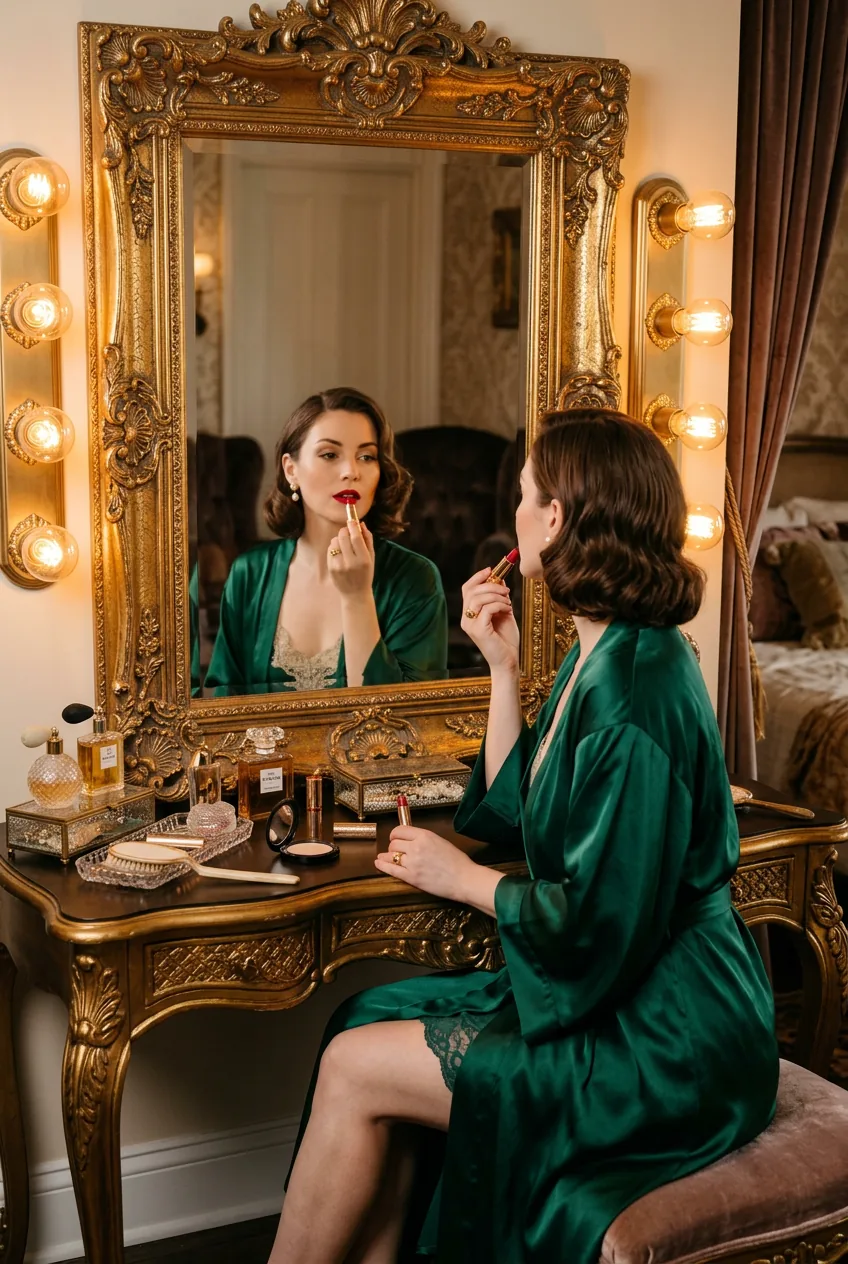
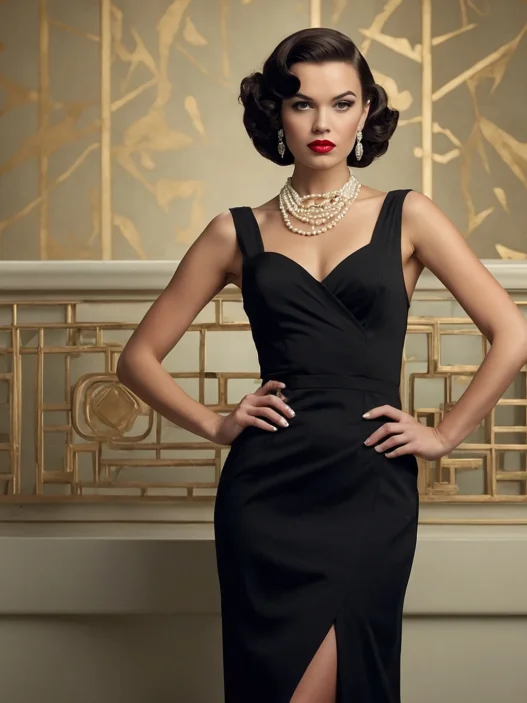
Look at her in this photo — she’s moving through that lobby like she’s entirely unaware of the cameras, and that ease is doing more work for the outfit than the gown itself is. The silhouette is doing its job, but the carriage is doing the heavy lifting. That’s what I mean when I say this aesthetic rewards a certain kind of comfort with formality.
For occasions where you want the visual reference without the full commitment, elements of this aesthetic translate beautifully into classy summer outfits — wide-leg linen trousers, a silk halter top, oversized sunglasses — or into sophisticated evening looks that borrow the proportions without demanding the full period vocabulary. That’s not compromise. That’s intelligent translation.
How This Style Ages in 10 Years
Here’s a question I genuinely think about: will the current wave of Old Hollywood-inspired fashion in 2026 look dated in 2036 the way certain 2010s trends already do? My honest answer is: partially, in ways that are predictable if you know what to look for.
The elements that will age are the ones that are being deployed as trend signals rather than as considered style choices. Heavy satin in that particular champagne color that’s everywhere right now — that has a trend shelf life. The specific execution of the red lip that’s popular on social media, with its very precise overdrawn cupid’s bow — that will photograph as very 2025–2026 within five years. The ultra-long slip dress with sneakers combination, which is trying to merge Old Hollywood with streetwear, will look exactly as period-specific as platform shoes with ballgowns from a previous era.
What won’t age: the underlying principles. A well-cut bias column in navy crepe will be beautiful in 2036 the same way it was beautiful in 1936. A structured blazer with wide-leg trousers in a strong shoulder proportion — that silhouette comes back every decade because it’s architecturally sound. The details that are specific to any given cultural moment will feel dated; the underlying geometry is permanent.
This is why I’d encourage investing in the construction rather than the trend execution. If you’re going to spend money on this aesthetic, spend it on something with a clean bias cut, quality fabric, and simple lines. Avoid the embellishments and styling details that are being overused on social media right now. You can read up on which fashion pieces hold their value to build a frame for this kind of thinking across your whole wardrobe.
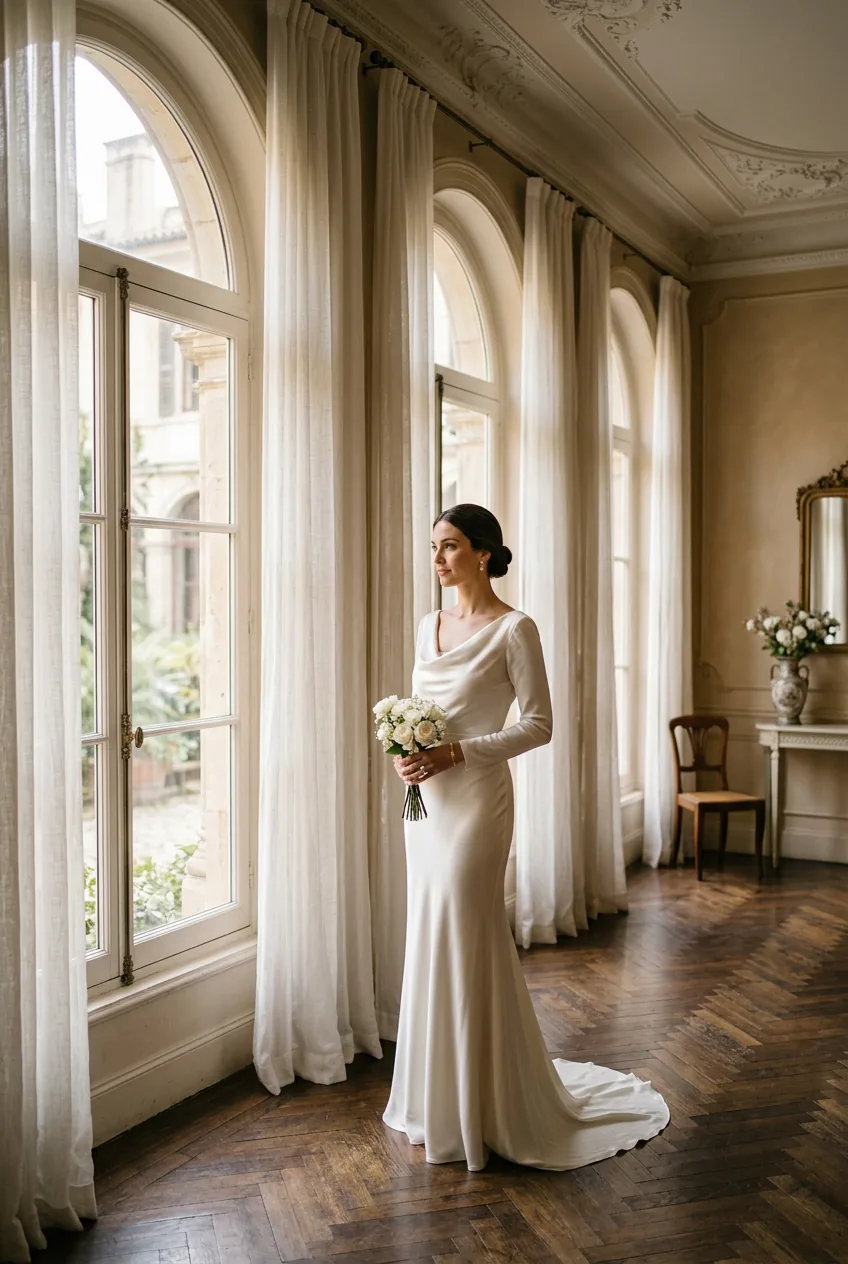
The other longevity factor is fit. I genuinely believe that a garment that fits you correctly looks current indefinitely. The pieces in actual Old Hollywood wardrobes that still look breathtaking in photographs were made-to-measure. The modern version of that is finding a tailor. A perfect fit will outlast any trend. Period, literally.
For what it’s worth, I think Old Hollywood is one of the more durable fashion references precisely because it’s rooted in craft rather than in pure novelty. The silhouettes, the construction techniques, the vocabulary of structured glamour — these have been revived so many times because they’re genuinely effective as a visual language. They’ll continue to be revived. The trick is to engage with the core principles rather than the revival’s current surface-level expression.
Questions I Get About This
Can I wear Old Hollywood style without looking like I’m in a costume?
Absolutely — but the key is selective borrowing, not full period accuracy. Pick one or two strong elements (a column silhouette, a red lip, a structured shoulder) and let your modern context do the rest. The costume feeling comes from trying to replicate everything at once.
What’s the most accessible way to start with this aesthetic on a budget?
Wide-leg trousers and a silk blouse — or anything silk-adjacent in a solid color — will get you there faster and cheaper than any gown. Add a structured cardigan or blazer with a slightly exaggerated shoulder, a good lipstick, and simple jewelry. The silhouette does the work without the price tag of full eveningwear.
How do I find authentic vintage pieces without being taken advantage of?
Learn to identify period construction details before you shop: French seams, hand-stitched hems, metal zippers in gowns from before the late 1950s, and internal boning or structure in the bodice. If a seller is claiming 1940s provenance on a dress with a plastic zipper, walk away. Reputable vintage dealers will welcome questions about provenance and construction — that willingness to be transparent is itself a good sign.
Does Old Hollywood style work for shorter women?
Yes, with some silhouette adjustments. Full-length column gowns can visually compress a petite frame, so a tea-length or midi version often works better. Vertical details — a center seam, a long necklace, a monochromatic color story — restore the lengthening effect. The wide-shoulder structured jacket is also a petite-friendly Old Hollywood look because it adds stature rather than overwhelming it.
If you’ve made it this far, you clearly care about this more than the average Pinterest scroll — and I respect that enormously. Go slowly, invest in fit over novelty, learn a little history, and don’t take anyone’s Instagram version of this aesthetic as the full story. The real thing is more complicated, more interesting, and more wearable than the curated surface suggests.