











Three years ago, I was standing in my closet at 7:23 AM, running late for a client presentation, staring at a wall of blazers and feeling completely paralyzed. That morning, I made a decision that changed everything: I would stop choosing what to wear and start wearing what works. My corporate uniform was born out of pure frustration, but it’s become my secret weapon.
When It Started
The turning point wasn’t some grand revelation about minimalism or productivity. It was pure exhaustion. I was spending twenty minutes every morning trying on different combinations, second-guessing myself, and still walking into meetings feeling “off” about my outfit.
I started noticing something about the women I most admired in my industry. They all seemed to have found their “thing” — that signature look that made them instantly recognizable and always appropriately dressed. One creative director I knew wore the same silhouette in different colors. Another wore exclusively black blazers with statement jewelry.

The concept isn’t new, obviously. Steve Jobs had his black turtlenecks. But I’d never considered applying it to corporate wear until I realized I was suffering from what psychologists call decision fatigue — and it was happening before I even left the house.
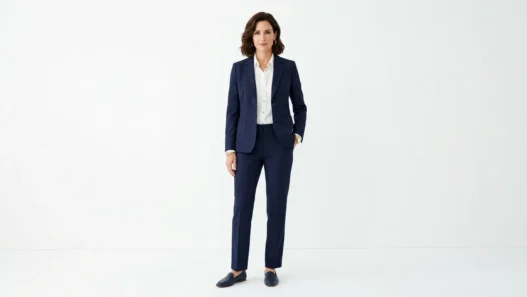
So I did an experiment. For one week, I wore variations of the same basic outfit: fitted blazer, tailored pants, silk blouse. Different colors, same formula. That week, I got three compliments on my style and felt more confident in every meeting. I was onto something.
Why It Works
There’s actual science behind why uniforms reduce stress. When you eliminate small decisions, you preserve mental energy for bigger ones. But beyond the psychology, having a corporate uniform has practical benefits I never expected.
First, consistency builds recognition. People start associating you with a polished, intentional look. I’ve had colleagues tell me they think of me as “always well-dressed,” which honestly surprised me because I’m wearing basically the same thing every day. But that’s exactly the point — when something works, it works reliably.

Second, it eliminates the morning anxiety spiral. No more standing in front of my closet wondering if the navy blazer looks too formal or if this blouse goes with these pants. I grab, I go, I move on to thinking about actual work instead of fabric choices.
And here’s what really sold me: shopping became infinitely easier. Instead of buying random pieces that “might work,” I only buy things that fit my established formula. My success rate went from maybe 60% to close to 90%. I waste less money on impulse purchases and everything in my closet actually gets worn.
The most unexpected benefit? People assume I’m more organized than I actually am. When you look consistently put-together, people project that consistency onto other areas of your work. It’s a professional advantage I never saw coming.
The Pieces in Rotation
My uniform isn’t actually uniform in the strict sense — it’s more like a formula with variables. The structure stays the same, but the details shift to keep things from getting boring.
The foundation is always the same: tailored blazer, fitted blouse, straight-leg or wide-leg pants, and pointed-toe flats or low heels. But I play with textures, colors, and small details to keep it interesting.

I own four blazers in rotation: charcoal wool, navy cotton blend, cream linen, and a soft pink that adds warmth to my skin tone. Each works with multiple bottom and top combinations, which gives me way more outfit possibilities than you’d think.
For blouses, I stick to classic shapes but vary the details. Silk button-downs in white and cream, a few with subtle patterns, and one or two in jewel tones for days when I need extra confidence. The key is keeping the silhouette consistent so everything layers predictably.
Pants are where I allow the most variation. I have wide-leg trousers in navy and charcoal, straight-leg pants in black and gray, and one pair of well-fitted dark jeans for more casual days. All sit at the same spot on my waist, all work with every blazer.

Accessories are my secret weapon for variety. A statement necklace transforms the whole look. Different scarves, watches, or bags can make the same basic outfit feel completely fresh. I’ve learned that accessories matter more than I ever thought they would.
Shoes rotate between three options: black pointed-toe flats, nude low heels, and brown leather loafers. That’s it. Each works with every outfit combination, so I never have to think about matching.
See the Formula in Action
What I’ve Let Go Of
Building a uniform meant saying goodbye to things I thought I needed. This was harder than I expected, not because the pieces were particularly meaningful, but because I had to admit that most of my wardrobe wasn’t actually serving me.
I donated an entire section of “statement pieces” that I’d bought thinking they’d make me look more creative or interesting. Turns out, wearing something that feels authentically you is far more interesting than wearing something attention-grabbing that doesn’t fit your actual lifestyle.

The hardest category to let go of was “occasion wear” — pieces I’d bought for specific events that I kept thinking I’d wear again. That sequined top from a holiday party three years ago? The colorful wrap dress I wore to one wedding? They were taking up physical and mental space without adding value to my daily life.
I also stopped buying trendy pieces that didn’t fit my formula. This was a mindset shift that took months to fully embrace. When everyone was wearing fall fashion trends that didn’t align with my style, I had to resist the urge to participate.
But here’s what surprised me: I don’t miss the variety as much as I thought I would. When you know you look good in what you’re wearing, you stop thinking about what you’re not wearing. The mental freedom is worth more than having fifteen different blazer styles.
I did keep a few pieces for non-work events — a little black dress, casual weekend clothes, workout gear. The uniform is specifically for my professional life, not my entire existence. Balance matters.
How to Build Your Own
If you’re considering your own corporate uniform, start by looking at what you already reach for repeatedly. Those pieces you grab when you’re running late or feeling uncertain? That’s your uniform trying to emerge naturally.
Don’t overthink the “rules” part. My approach works for my industry and body type, but yours might be completely different. Maybe you’re more comfortable in dresses than separates. Maybe your workplace calls for more casual pieces. The key is finding a formula that feels authentically you while meeting your professional needs.

Start with one week of wearing variations on the same basic outfit. Pay attention to how it makes you feel, how much time you save, and whether people respond differently to your consistent appearance. If it feels right, gradually build out the pieces you need to sustain the approach.
Invest in quality basics rather than quantity. When you’re wearing similar pieces frequently, they need to hold up to regular washing and wearing. I’d rather have two excellent blazers than five mediocre ones.
And give yourself permission to evolve the uniform over time. What works in your current role might need adjustment if you change jobs or industries. The goal isn’t to lock yourself into one look forever — it’s to create a system that serves you consistently.
My corporate uniform has given me something I didn’t know I was missing: the confidence that comes from knowing you look appropriate and polished, no matter what the day brings. When chic winter date night outfits require more creativity, I can pivot. But for my 9-to-5 life, the decision is already made.
Some mornings I catch myself in the mirror and think, “I look exactly like myself.” That’s become my definition of getting dressed right.