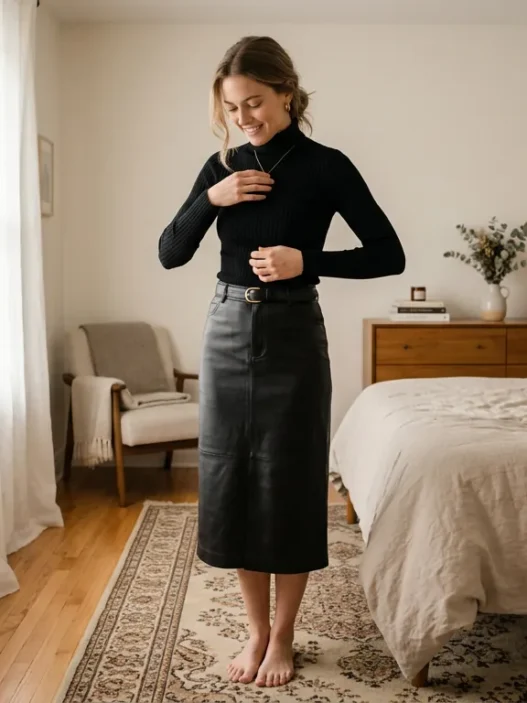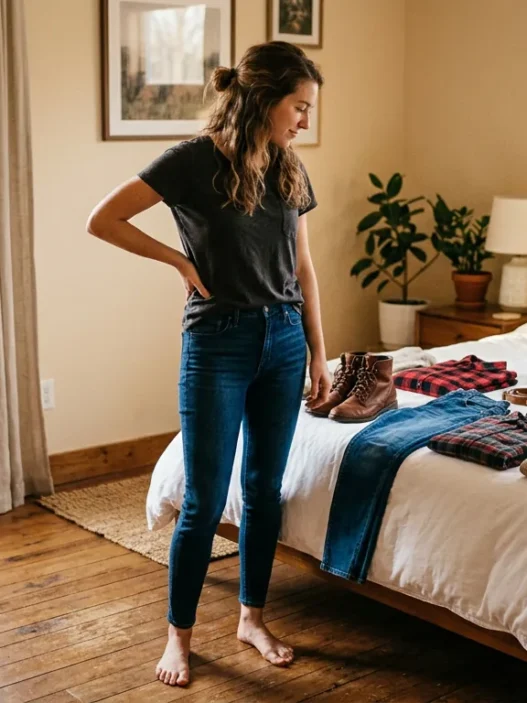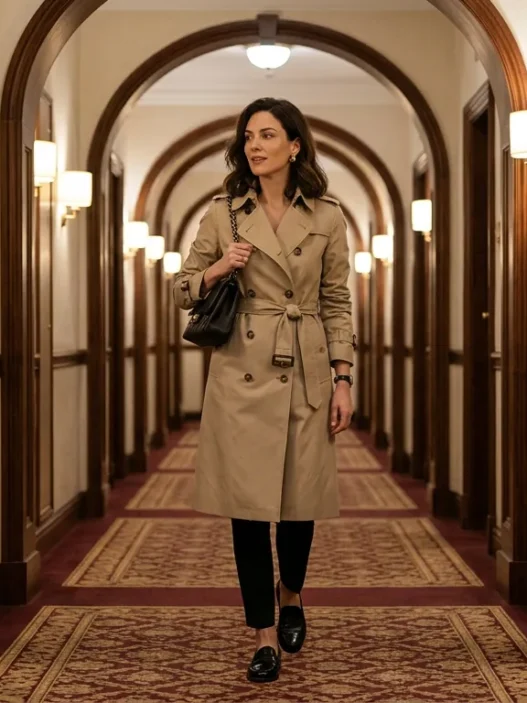








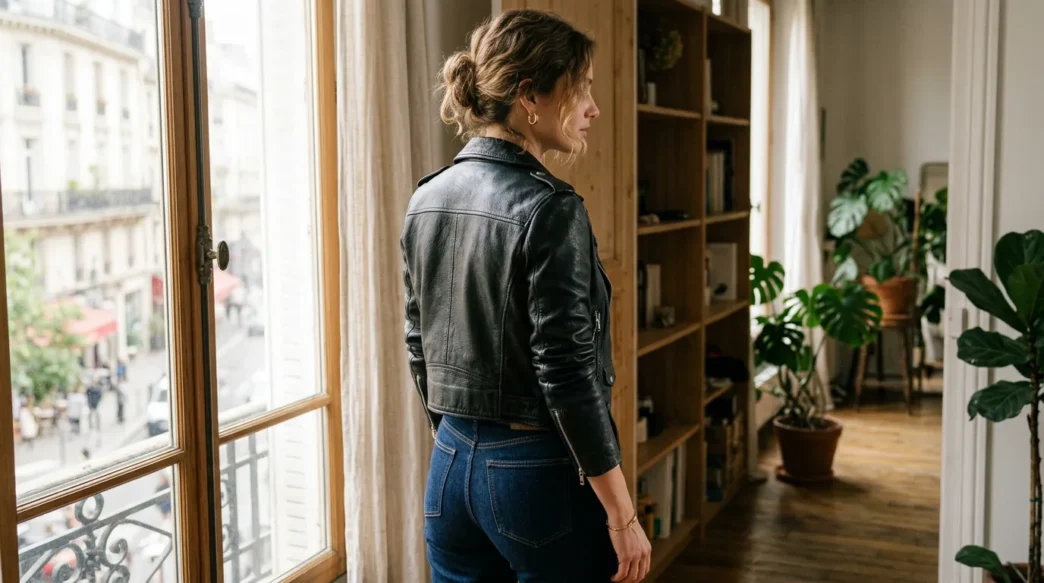
I used to treat my black leather jacket like a punctuation mark — something I threw on at the end when an outfit felt incomplete. It never really worked. The jacket always looked like an afterthought, floating over whatever I’d already assembled, rather than being the reason the whole look made sense. Then I flipped the process entirely. I started with the jacket. And everything changed.
This guide is the exact method I follow now. Six sequential steps, one result: an outfit that looks like it was planned by someone who actually knows what they’re doing. Which, after a lot of trial and error, I finally do.
How to Build the Outfit — What’s Inside
- Why One Anchor Piece Works
- Picking the Right Black Leather Jacket
- Step 1: Nail the Foundation Layer
- Step 2: Choose Your Bottom Half
- Step 3: Add the Jacket — Proportions First
- Step 4: The Supporting Pieces That Don’t Compete
- Step 5: Shoes That Finish the Story
- Step 6: The Final Edit
- Adjusting for Different Body Types
- Questions I Get About This
Why One Anchor Piece Works
The anchor-piece method isn’t a new concept in styling — it’s actually how most professional stylists approach a shoot. They pick one statement item and build outward, making sure every other piece either echoes it, contrasts it intentionally, or steps back to let it lead. What trips most of us up is doing this in reverse: we build the outfit first and then wonder why the leather jacket on top looks chaotic.
A black leather jacket is particularly powerful as an anchor because it has a strong personality. It’s structured. It has weight. It carries an edge that will either clash with or define everything around it. That’s why you have to start there — so everything else gets chosen in conversation with the jacket, not in spite of it.
Think of it like decorating a room around a rug. The rug sets the palette, the mood, the scale. Everything else responds. Your jacket is the rug.
Picking the Right Black Leather Jacket
Before we get into the steps, I want to spend a moment on fit — because not all black leather jackets are equal anchors. A boxy, oversized moto sits completely differently than a cropped, fitted blazer-style leather jacket. Both are great. They just produce entirely different outfits.
For this guide, I’m working with a fitted, hip-length moto jacket — the kind with asymmetric zip, maybe a small collar, and sleeves that hit right at the wrist bone. It’s the most versatile cut for this method. If yours is cropped or boxy, I’ll call out adjustments along the way.
What to look for when picking your anchor jacket:
- Shoulders sit exactly at your shoulder seam — not drooping, not pulling upward
- You can close it comfortably with a sweater underneath but it doesn’t gap
- The hem hits at or just below your natural hip — this controls proportion everything
- Hardware (zippers, buckles) feels intentional, not decorative clutter
- Real or high-quality vegan leather — cheap bonded leather wrinkles wrong and reads cheap instantly
How to assess leather quality is worth a read if you’re shopping right now. The difference between a jacket that anchors an outfit and one that just sits on top of it is almost always fit.
Step 1: Nail the Foundation Layer
The foundation layer is what you wear directly under the jacket. It’s the piece that peeks out at the collar, maybe at the hem, and it sets the entire tonal direction of the outfit. Get this right and the rest practically decides itself. Get it wrong and the whole thing fights.
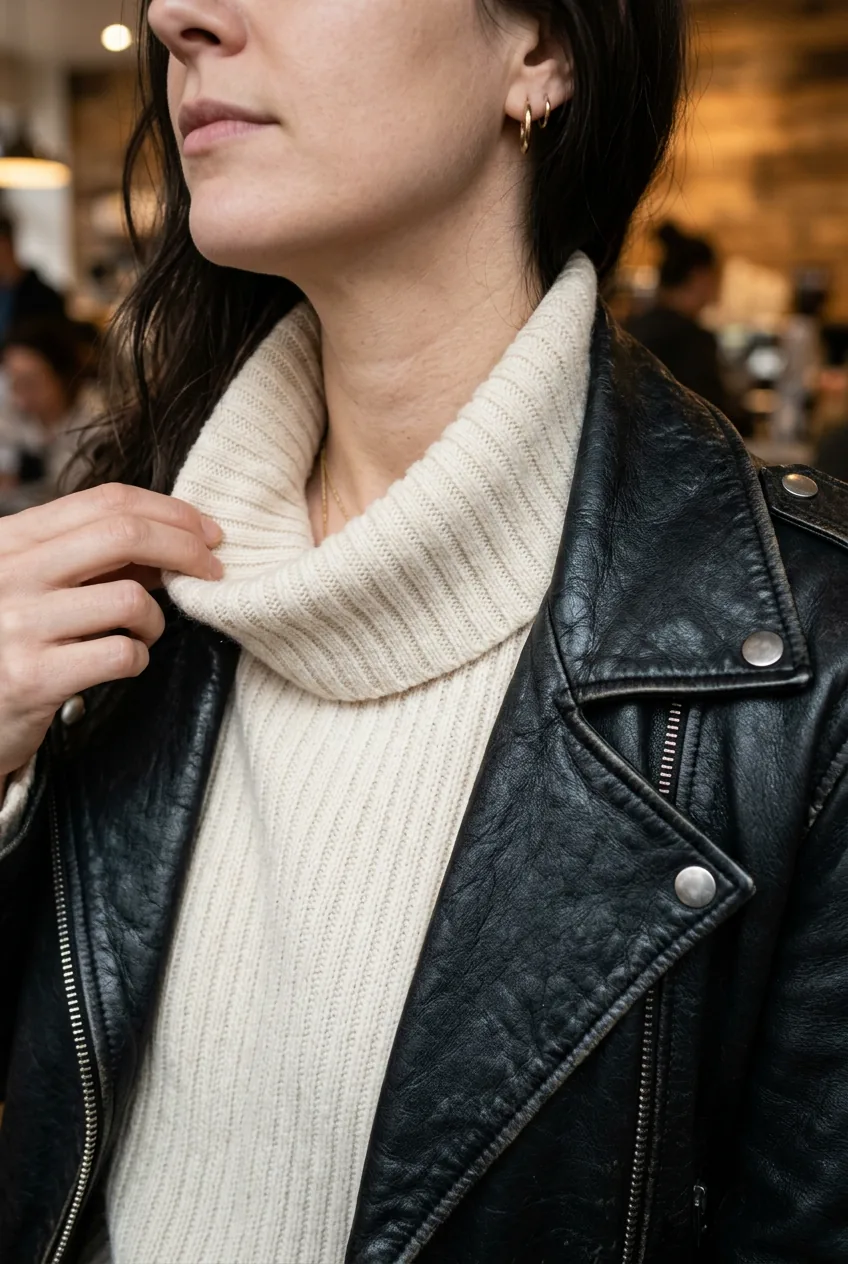
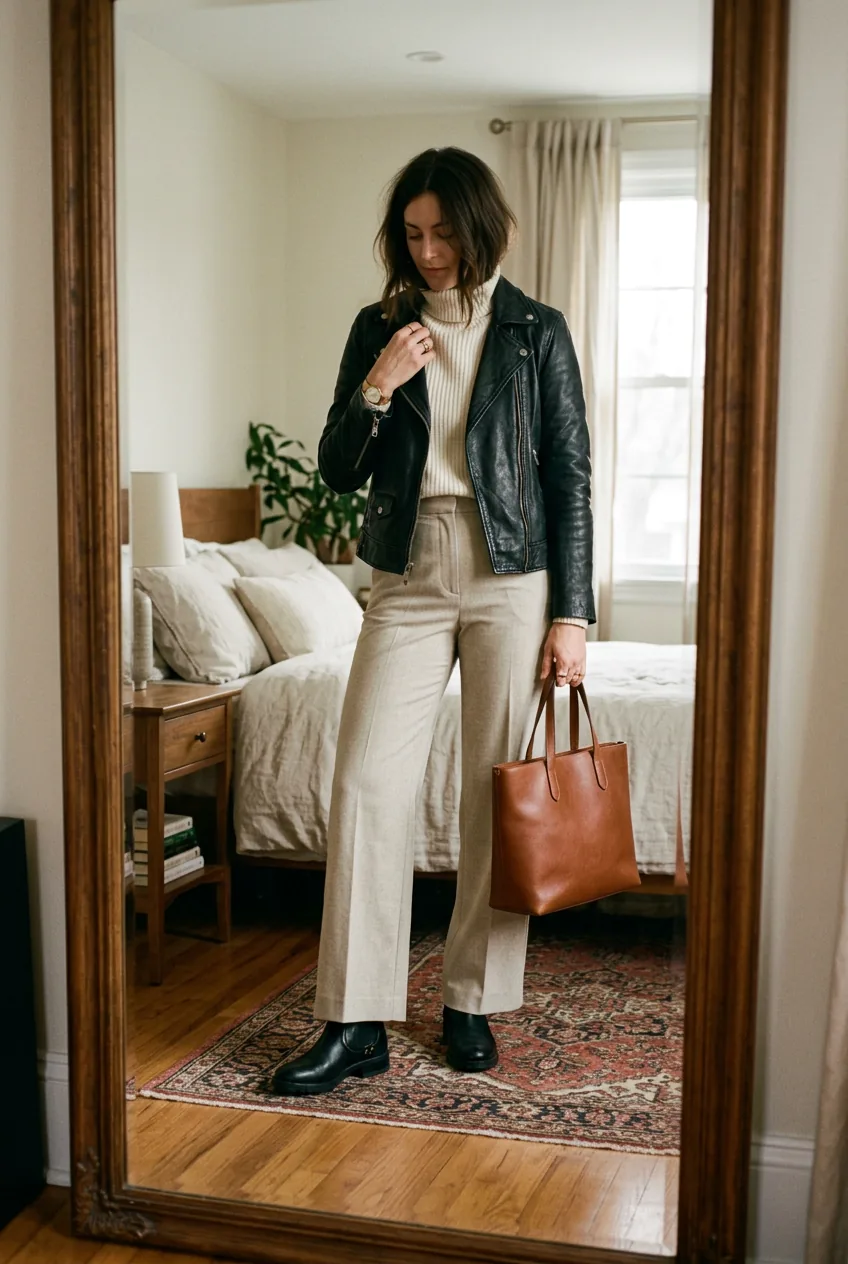
My personal favorite foundation layer is a fine-knit ribbed turtleneck in ivory or cream. The contrast against black leather is clean and editorial. It also fills the neckline in a way that feels intentional — no awkward gap, no competing collar.
Other foundation layers that genuinely work:
- A fitted white or grey crewneck tee (the classics exist for a reason)
- A thin black mock-neck for a monochromatic, very French effect
- A striped Breton — the nautical contrast against the moto edge is unexpectedly perfect
- A lightweight hoodie in a muted tone, if your jacket is relaxed-fit
What doesn’t work? Anything that competes for visual attention at the neckline. Ruffles, busy prints, a low-cut top that creates empty chest space under the jacket collar — all of these undermine the jacket’s authority. The foundation layer should whisper. The jacket shouts.
Mistake I made: I once layered a silky printed blouse as my foundation, thinking the jacket would “calm it down.” It did not. The pattern kept peeking out at the collar and hem and the whole thing looked busy and unresolved. The jacket needs a quiet base. Always.
Step 2: Choose Your Bottom Half
This is where most people rush. They pick bottoms based on what they feel like wearing that day, independent of the jacket. But the bottom half is in direct conversation with the jacket’s hem — and that relationship is everything.
A hip-length moto jacket creates a strong visual break at the hip. Your bottom half needs to either lean into that and elongate the leg, or create deliberate contrast in a way that looks styled rather than accidental.
The best options in 2026:
- Straight-leg or wide-leg jeans in a medium to dark wash — the volume at the leg balances the structured jacket beautifully. This is my most-worn combination.
- A midi skirt in a fluid fabric — the contrast between the hard leather and a soft, falling skirt is genuinely stunning. Bias-cut satin or a suede-effect fabric work best.
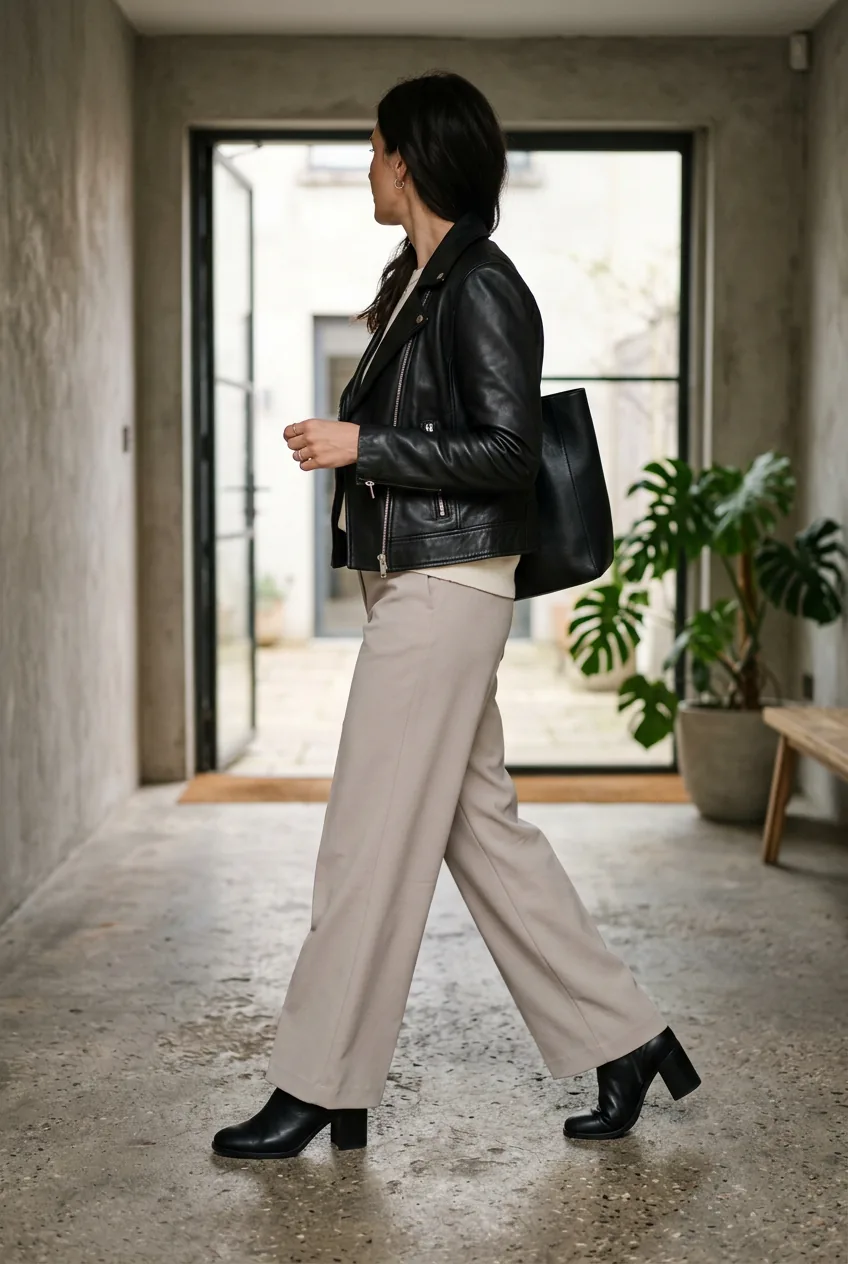
- Tailored trousers in a neutral — camel, stone, or charcoal all read sophisticated. This combination looks surprisingly polished, almost like an accidental suit.
- A mini skirt — works if the jacket is long enough to provide visual counterbalance. Too cropped a jacket with a too-short skirt leaves nowhere for the eye to rest.
One thing I’d avoid: mid-wash skinny jeans. Not because they’re “out” — but because the slim silhouette fights the jacket’s structured width for dominance. You end up with a top-heavy look that doesn’t feel intentional.
If you’re building stylish winter layers around this jacket, the wide-leg trouser route gives you the most room to add pieces underneath without the silhouette collapsing.
Step 3: Add the Jacket — Proportions First
Now you actually put the jacket on. But before you close it, fasten it, or push up the sleeves, I want you to look at one thing: where the hem lands relative to your bottom half.
The hem of the jacket should hit at the widest part of your hip or just below it. If it cuts across the middle of your hip — that awkward halfway point — it visually shortens and widens the torso simultaneously. Not the goal.
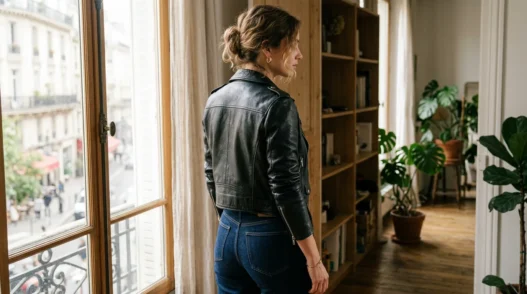
Look at her in this shot — she’s wearing hers with the hem landing exactly at the hip bone, and you can see how the eye travels cleanly from shoulder to hem to leg. That uninterrupted line is what makes the whole thing look effortless rather than assembled.
The sleeves should hit at the wrist bone, maybe showing just a sliver of the foundation layer beneath — an inch of ribbed turtleneck or a flash of white cuff. That peeking layer detail is subtle but it makes the outfit feel layered and considered.
Should you wear it open or closed? I wear mine open about 80% of the time. Closed creates a more structured, intentional silhouette — great for tailored trousers. Open creates a relaxed frame around the foundation layer — better with jeans or a skirt. Try both before you decide.
Step 4: The Supporting Pieces That Don’t Compete
This step is where most styling guides just say “accessorize!” and then list seventeen options. I’m going to be more specific, because the supporting pieces for a leather jacket outfit have one very clear rule: they should feel like they belong to the same world as the jacket, not a different outfit entirely.
The jacket is already doing a lot of visual work. It has texture, structure, hardware. Your supporting pieces need to either echo its energy or provide thoughtful contrast — not add noise.
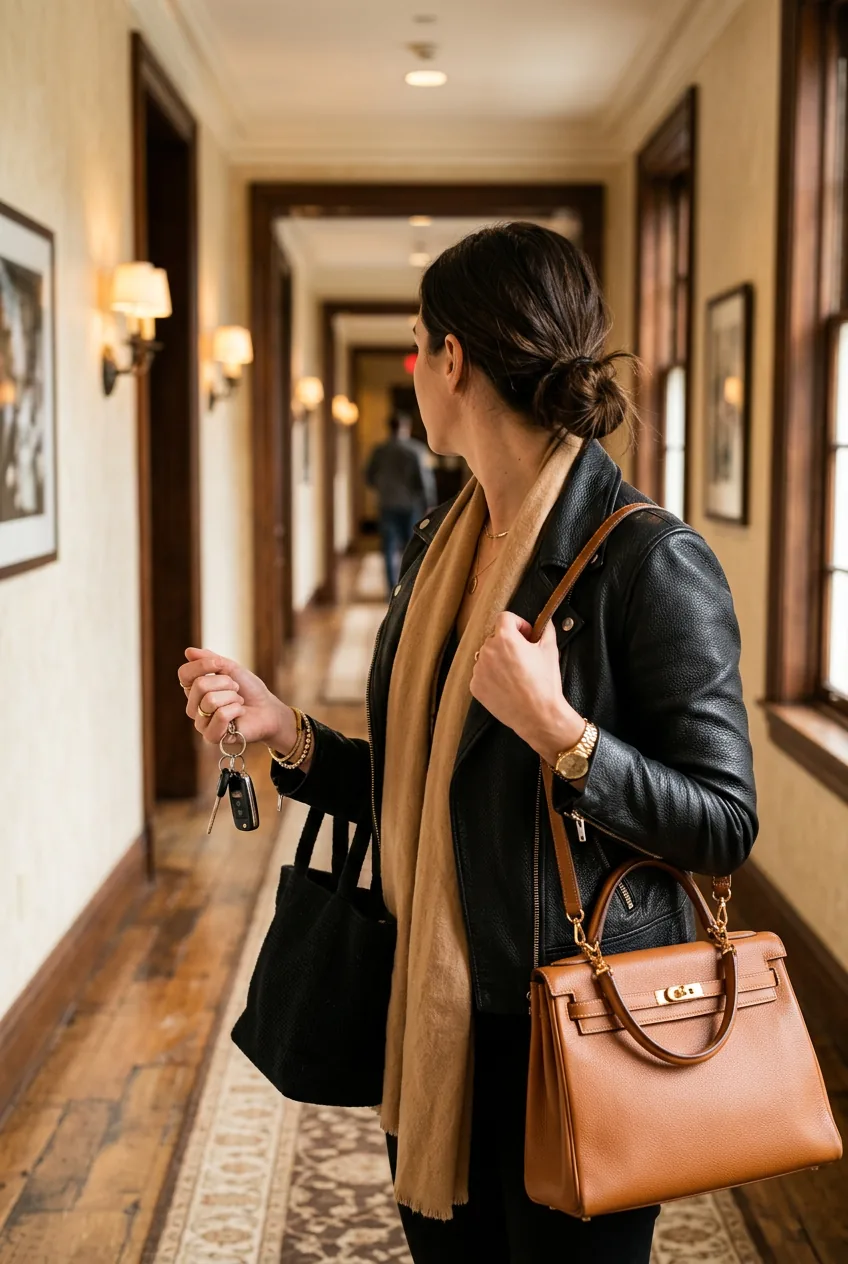
Bags. A structured bag in a contrasting tone — cognac leather, soft camel, even a deep burgundy — works beautifully against black. Avoid another black bag unless you’re going full monochromatic intentionally. The bag should feel like it was picked, not grabbed.
Jewellery. Keep it minimal and metallic. Gold hoops or small silver cuffs. The jacket’s hardware already brings visual metal to the look — any heavy statement necklace is going to compete with that asymmetric zip. Less here is genuinely more.
A scarf, if the weather calls for it. Tucked loosely into the collar, a lightweight cashmere scarf adds softness that balances the jacket’s edge. This combination is one of my absolute favourites for early autumn — it bridges the jacket’s toughness with something that feels relaxed and warm.
The same logic applies if you’re putting together cozy winter outfits that are still stylish — every supporting piece earns its place by working with the anchor, not despite it.
Step 5: Shoes That Finish the Story
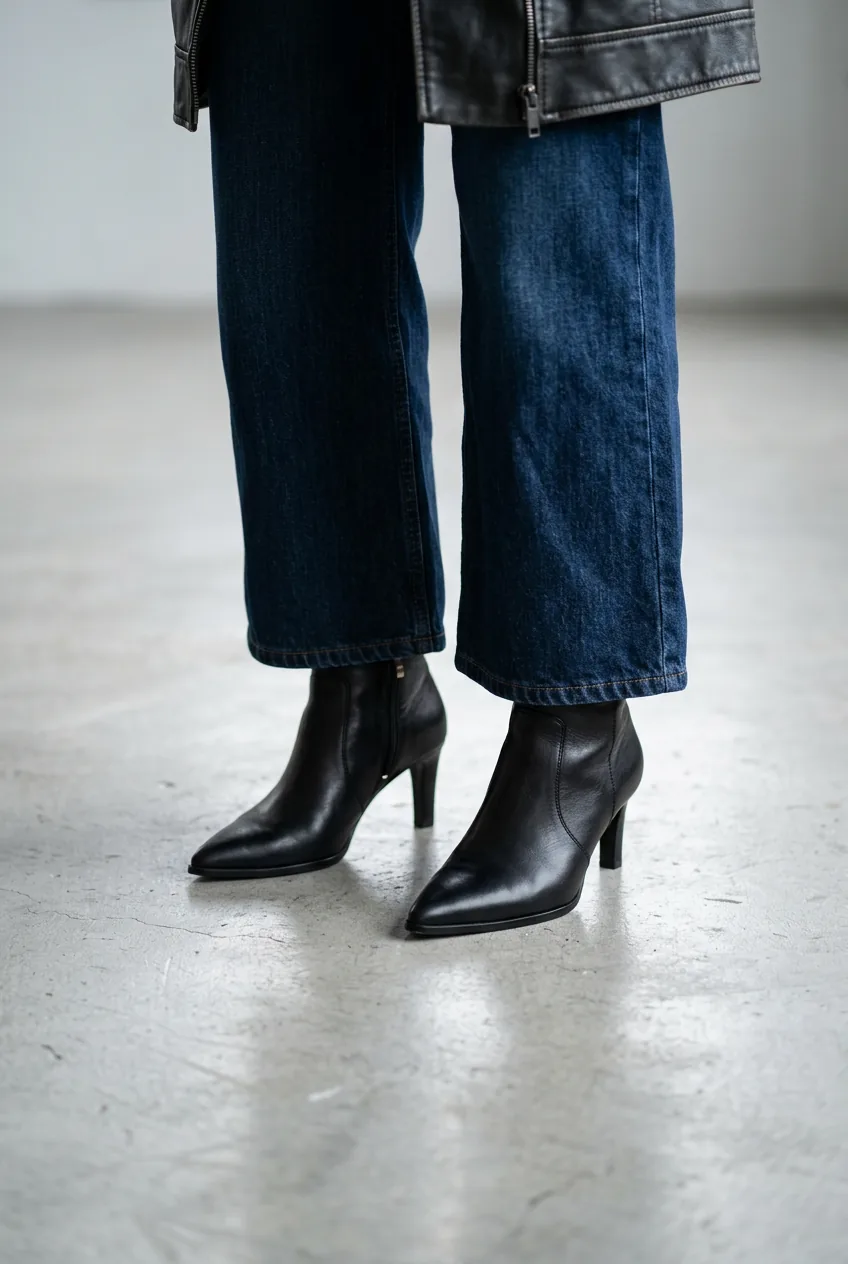
Shoes are the punctuation. They tell you what kind of sentence the outfit is. The same black leather jacket over the same wide-leg jeans reads completely differently in chunky loafers versus ankle boots versus white trainers. This is genuinely one of the most powerful styling moves available to you.
Here’s how I think about it, based on what the rest of the outfit is already doing:
- Ankle boots with a slight heel — the most natural pairing. It keeps the edge going, elongates the leg, and feels like the jacket’s logical companion. Black or brown both work.
- White chunky trainers — this introduces a deliberate softness and nods to the whole elevated-casual thing that’s still very much having a moment in 2026. Great with wide-leg jeans.
- Pointed-toe flats or ballet flats — unexpectedly chic. The delicacy of a flat against the leather jacket’s toughness creates that contrast-dressing effect that stylists love.
- Knee-high boots over a midi skirt — honestly one of my favourite combinations ever. The boot’s height, the skirt’s length, the jacket’s structure — everything has presence without anyone piece overwhelming the others.
What I’d avoid: platform trainers or very chunky boots with a structured jacket over tailored trousers. The silhouette becomes top-heavy and bottom-heavy simultaneously — nothing to anchor the middle.
Step 6: The Final Edit
This is the step that separates a good outfit from a great one. Stand in front of a full-length mirror and give the look one honest edit. Not a tweak — an edit. You’re looking for anything that’s competing with the jacket or doesn’t belong to the same story.
Ask yourself three things:
- Is anything fighting the jacket for dominance? (A loud bag, a fussy scarf, too many layers visible at the collar?)
- Is the proportion clean from shoulder to foot? (No awkward hem breaks, no bunching, nothing cutting the leg mid-thigh unnecessarily?)
- Does the shoe feel like it was chosen for this outfit or just grabbed from the door?
If yes, yes, and chosen — you’re done. If any answer is no, remove one thing or swap one thing. Often the edit is subtractive. Take off the belt you added. Swap the patterned scarf for a plain one. Remove one layer of jewellery. The jacket does enough.
This is the same principle that applies when you’re building any outfit around a strong outerwear piece — whether that’s following the 6-step formula for a denim jacket outfit or working with your leather moto. The edit is always the last step and the most important one.
Adjusting for Different Body Types
The anchor-piece method works across body types, but the proportional logic shifts slightly depending on your specific silhouette. Here’s what I’ve found actually makes a difference.
If You’re Petite
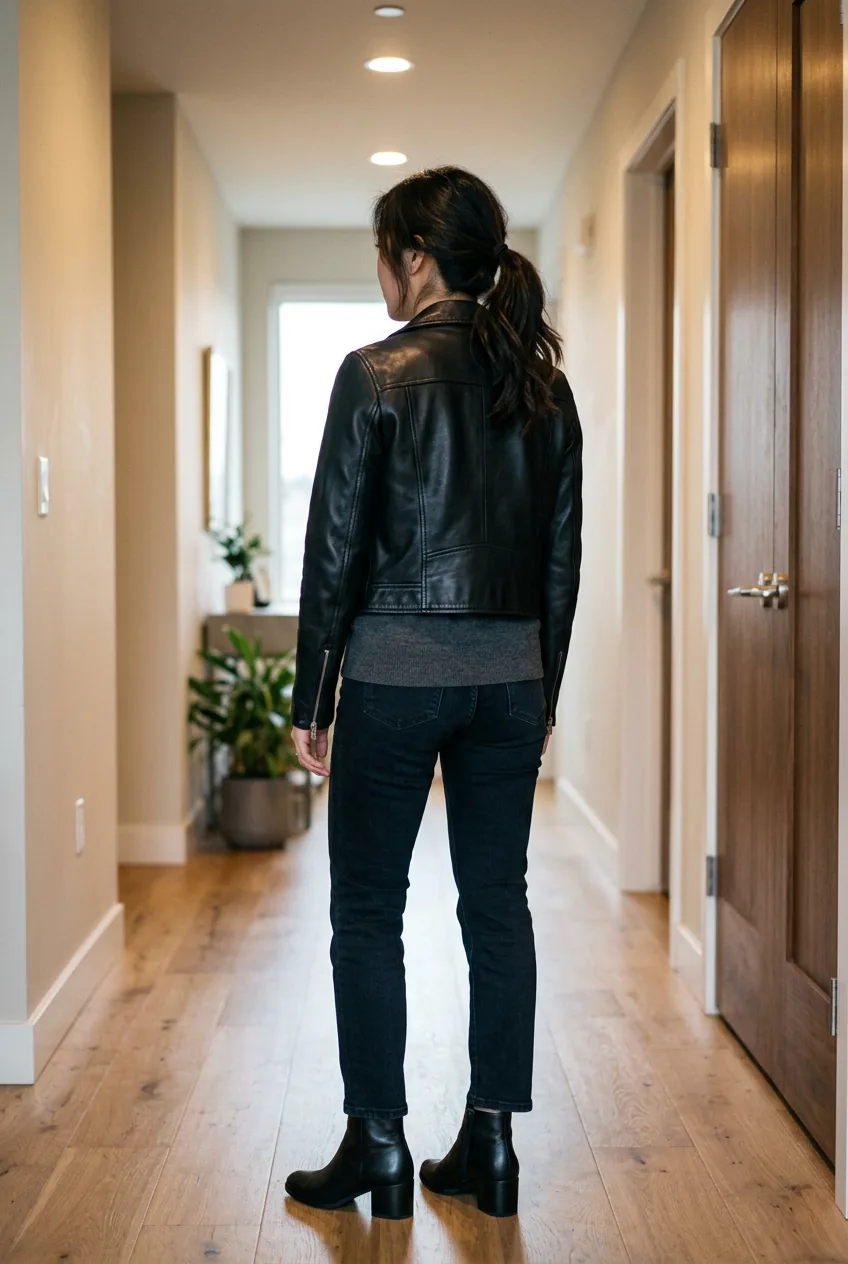
A cropped or hip-length jacket works better than anything that hits mid-thigh — too much jacket overwhelms a smaller frame. Pair with straight-leg or slim trousers rather than wide-leg, and keep the entire colour palette tonal so there are no harsh breaks that visually chop your height. Low-heeled ankle boots are your best friend here. She’s wearing a nearly identical combination in the image below — notice how the clean lines from jacket hem to boot create one uninterrupted vertical read. That’s the goal.
If You Have a Fuller Bust
Avoid a foundation layer with a very high neckline — a mock-neck turtleneck under the jacket can create a bulky column effect across the chest. A fine-knit crewneck or a V-neck that peeks just slightly at the jacket’s open collar is more flattering. Make sure the jacket sits properly across the shoulders and isn’t straining across the chest — this is usually a sign to size up and take in elsewhere if needed.
If You’re Tall
You can carry a longer jacket length — something that grazes the upper hip or even mid-hip — without it shortening your frame. Wide-leg trousers look particularly incredible on a taller silhouette with a leather jacket because the volume is balanced by the height. And you can afford bolder shoe choices — a chunkier boot, a platform, or even knee-high boots without the look tipping into overwhelming.
If You’re Curvy
A belted leather jacket — or one that cinches slightly at the waist — defines your silhouette in a way a boxy cut won’t. If yours has adjustable side buckles, use them. Pair with a midi skirt in a fluid fabric and you’ve got one of the most flattering combinations possible. The structured jacket on top, the soft skirt below — it’s the contrast that works, not minimising your shape.
For even more ideas on building outfits with strong silhouette pieces, the collections on glam cowgirl outfits are worth browsing — the same proportion logic applies even in a completely different aesthetic direction.
Questions I Get About This
Can I wear a black leather jacket with all-black everything?
Absolutely — but you need to vary the textures or it all blurs together. A matte knit foundation layer, the sheen of leather, and a smooth trouser fabric gives the eye enough variation to read as styled rather than monotone. All-black works; all-flat-black doesn’t.
How do I make a leather jacket look less edgy and more polished?
The foundation layer and the shoes do most of that work. A cream turtleneck and pointed-toe ballet flats under a leather jacket reads nearly preppy. Tailored trousers push it firmly into polished territory. Smart-casual leather styling has more ideas if you’re navigating a dress code situation.
Is a vegan leather jacket as good an anchor piece as real leather?
Yes, if the quality is high. The key is drape and sheen — good vegan leather catches light and holds its structure. Cheap bonded leather develops creases that look unintentional rather than worn-in. Spend where you can on the jacket; it’s the anchor and it shows.
Can I wear a black leather jacket in warmer months or is it strictly a fall piece?
A light leather jacket is genuinely a three-season piece. In spring and summer, ditch the foundation knit for a thin cotton tee or a sleeveless bodysuit. The jacket over a sundress on a cool evening is one of those combinations that photographs brilliantly and feels even better in person. Summer evenings are practically made for it.
The first time I wore this outfit — cream ribbed turtleneck, wide-leg stone trousers, my moto jacket open, cognac tote, ankle boots — I got three compliments in one afternoon. One from a stranger on the train. I’m not usually someone who registers compliments as validation, but this one felt different because I knew exactly why the outfit worked. I’d built it with intention. The jacket led; everything else followed. That’s the feeling I want you to have when you walk out the door.