







I used to own three leather jackets and wear exactly zero of them with any confidence. They’d just hang there, looking cool by themselves, judging me every morning. The problem wasn’t the jackets — it was that I had no actual process. I’d throw one on over whatever I was already wearing and wonder why the whole thing felt off. So I broke down every single decision, from the first piece I put on my body to the last thing I adjust before walking out the door, and what I ended up with is this guide. It changed how I get dressed completely.
Pieces, Proportions, and Palette Overview
Before you pull anything out of your closet, it helps to understand the three forces at play in every good leather jacket outfit: the pieces you choose, the proportions they create together, and the palette that ties them into something that looks intentional rather than accidental. Getting all three right is honestly the difference between looking like you tried too hard and looking like you just threw something on and it happened to be perfect.
Pieces: A leather jacket is what I call a “strong outerwear” piece — it has a defined shape, a fixed visual weight, and a personality all on its own. That means everything underneath it needs to be calmer. Think fitted over voluminous, simple over busy, smooth over textured (at least for the base). The jacket does the talking. Your other pieces are the listening.
Proportions: The classic rule is fitted jacket, wider bottom — or slim jacket, slim bottom with a longer top tucked or half-tucked to break the line. A cropped moto jacket demands high-waisted anything. A longer, drapey leather blazer-style jacket wants slim trousers. Proportion isn’t fashion theory — it’s just visual balance, and once you feel it, you can’t unfeel it.
Palette: Leather jackets are naturally a neutral — even a red or white one reads as a base, oddly enough, because the texture itself is so dominant. Classic black leather pairs with literally everything, so I’d recommend starting there. But if you’re working with a brown or tan jacket, you’re essentially building a warm-toned outfit, which means leaning into creams, rust, olive, and camel rather than cool greys or icy blues. If you want to go unexpected, neutral palette dressing is a great rabbit hole for palette inspo.
Keep all three in mind as you work through each phase below. They’re the invisible architecture of the whole look.
Phase 1: The Base Layer
This is where most people go wrong — including past me. The base layer isn’t just whatever shirt you already have on. It’s actually the most load-bearing piece in the entire outfit because it determines how the jacket sits, what the neckline looks like when the jacket is open, and whether the whole silhouette reads as intentional or chaotic.
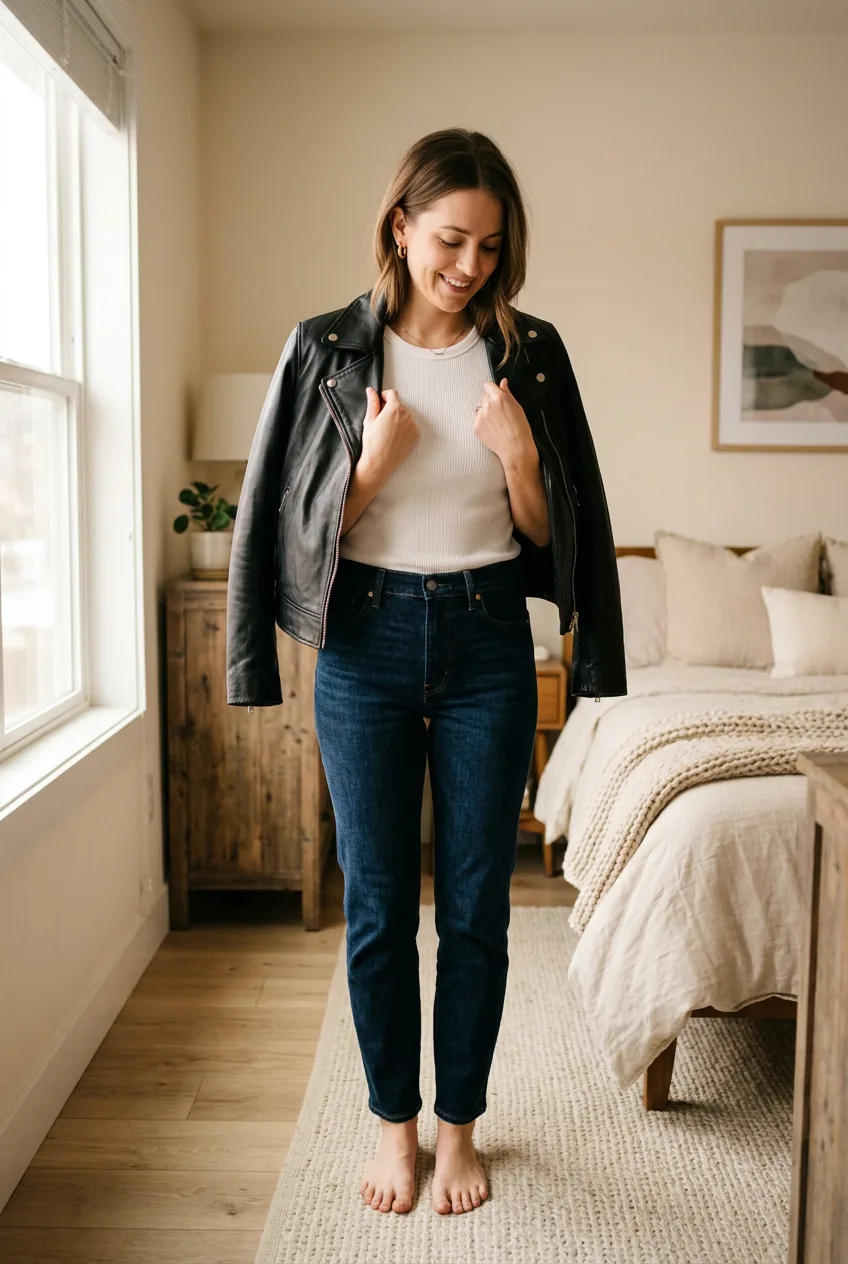
Start by choosing your base based on your jacket’s collar style. If you have a classic moto with a lapel or asymmetric zip, a fitted crewneck, ribbed mock neck, or even a simple white tee works beautifully — the top of the tee peeks out just enough to add a clean layer. If your jacket has a more open, relaxed collar (think oversized or drapey leather blazer silhouette), a fitted scoop neck or V-neck creates an intentional visual line instead of a confused one.
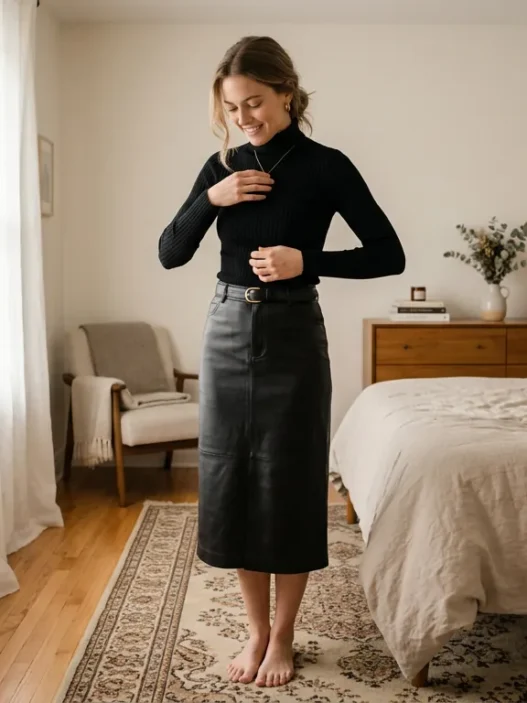
My personal go-to is a ribbed fitted white or cream tank when I’m doing a street-style-influenced look, or a fine-knit black turtleneck when I want something more polished. The turtleneck under leather is one of those combinations that somehow never goes out of style — it’s been showing up on runways and street style accounts in 2026 just as much as it did twenty years ago. The texture contrast does something magic.
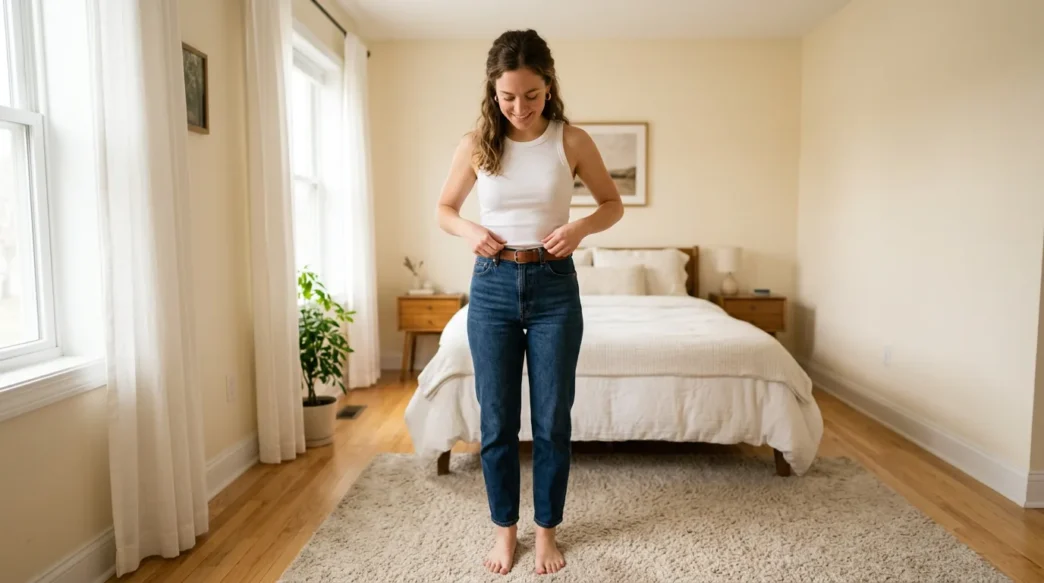
Also — and this matters — tuck or half-tuck at this stage. Don’t wait until the jacket is on. Decide now how you want the waistline to read, because once the jacket is over it, you can’t really adjust.
Mistake I made: I used to put on a chunky knit sweater under my leather jacket because I thought layering textures = more interesting. What actually happened was the sleeves bunched, the shoulders looked enormous, and the whole thing read «I’m cold, not stylish.» Save the chunky knit for a cozy winter outfit where it’s the star — not under a strong outerwear piece that competes with every inch of it.
Phase 2: Building the Silhouette
With your base layer set, now you’re adding the bottom half — and this is where proportions really come into play. I think of this as «building the frame» before the jacket goes on, because you need to see how the whole silhouette reads without the outerwear first. If it looks proportional without the jacket, it’ll look even better with it. If it already looks off-balance, the jacket won’t fix it.
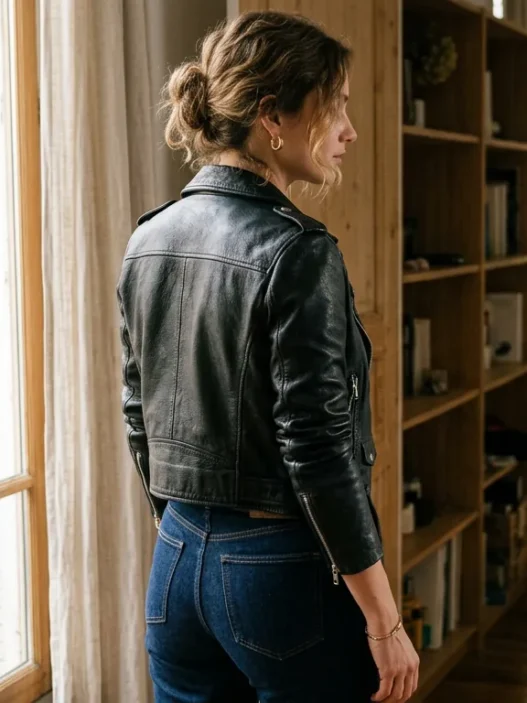
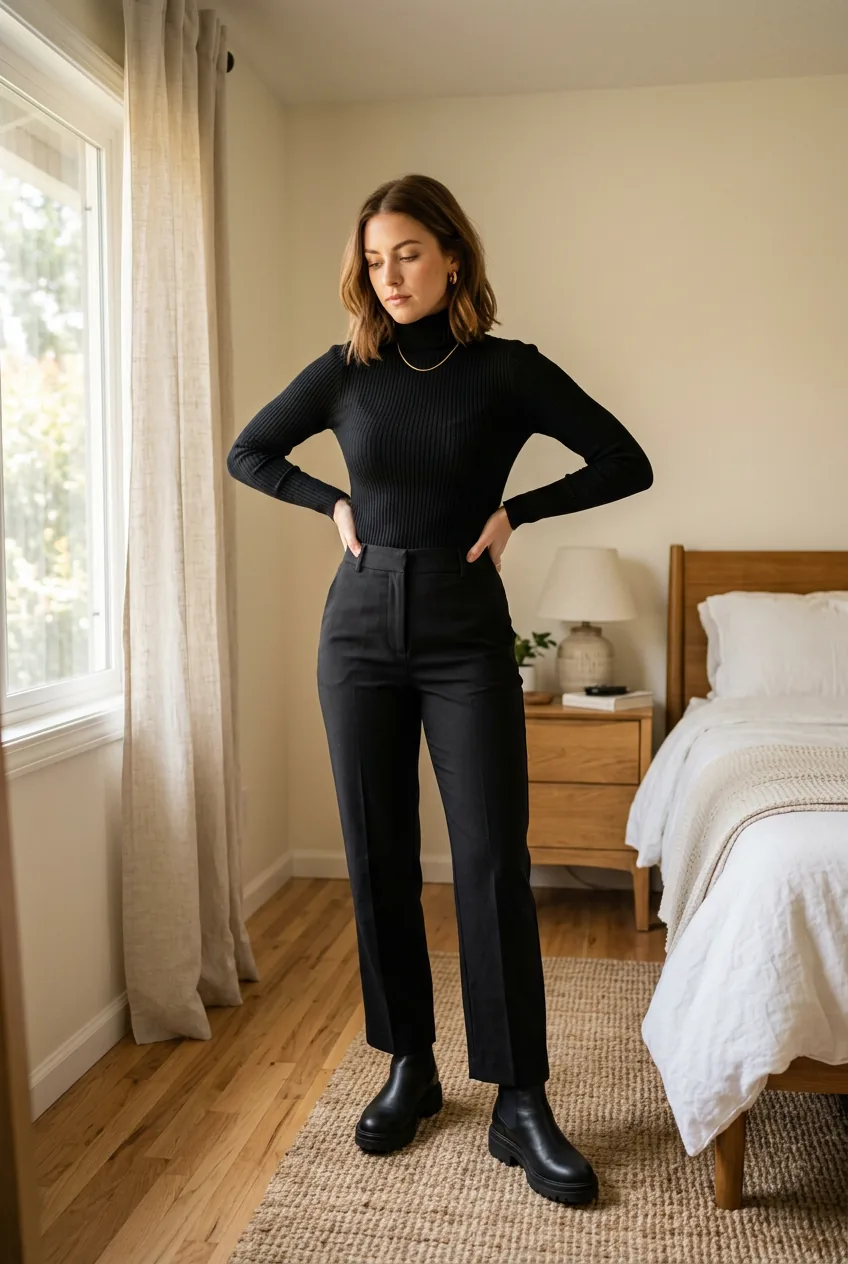
For a cropped or moto-style leather jacket, I almost always reach for something high-waisted. High-waisted straight-leg jeans in a medium or dark wash are genuinely a perfect match — they ground the jacket, balance the cropped hem, and elongate the leg. High-waisted black trousers give you a more polished, pulled-together result that works for casual Fridays or a dinner out. If you want to really commit to the «cool girl» silhouette, a mini skirt — leather, denim, or even a plaid — with tights and boots underneath plays beautifully.
For a longer, drapier leather jacket (the kind that hits mid-hip or lower), go the opposite way. Slim-cut trousers, skinny jeans, or fitted ankle-length pants keep the silhouette clean instead of swamped. This is also where a slip skirt in a satin or bias-cut fabric creates that unexpected feminine-versus-tough contrast that I find so satisfying to wear.
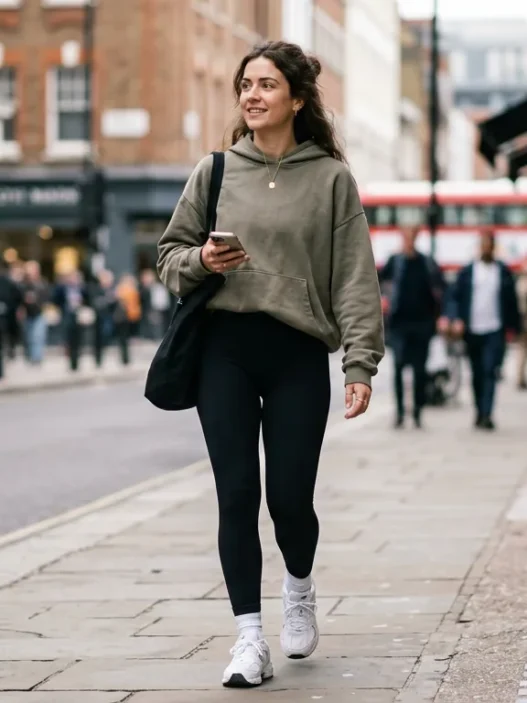
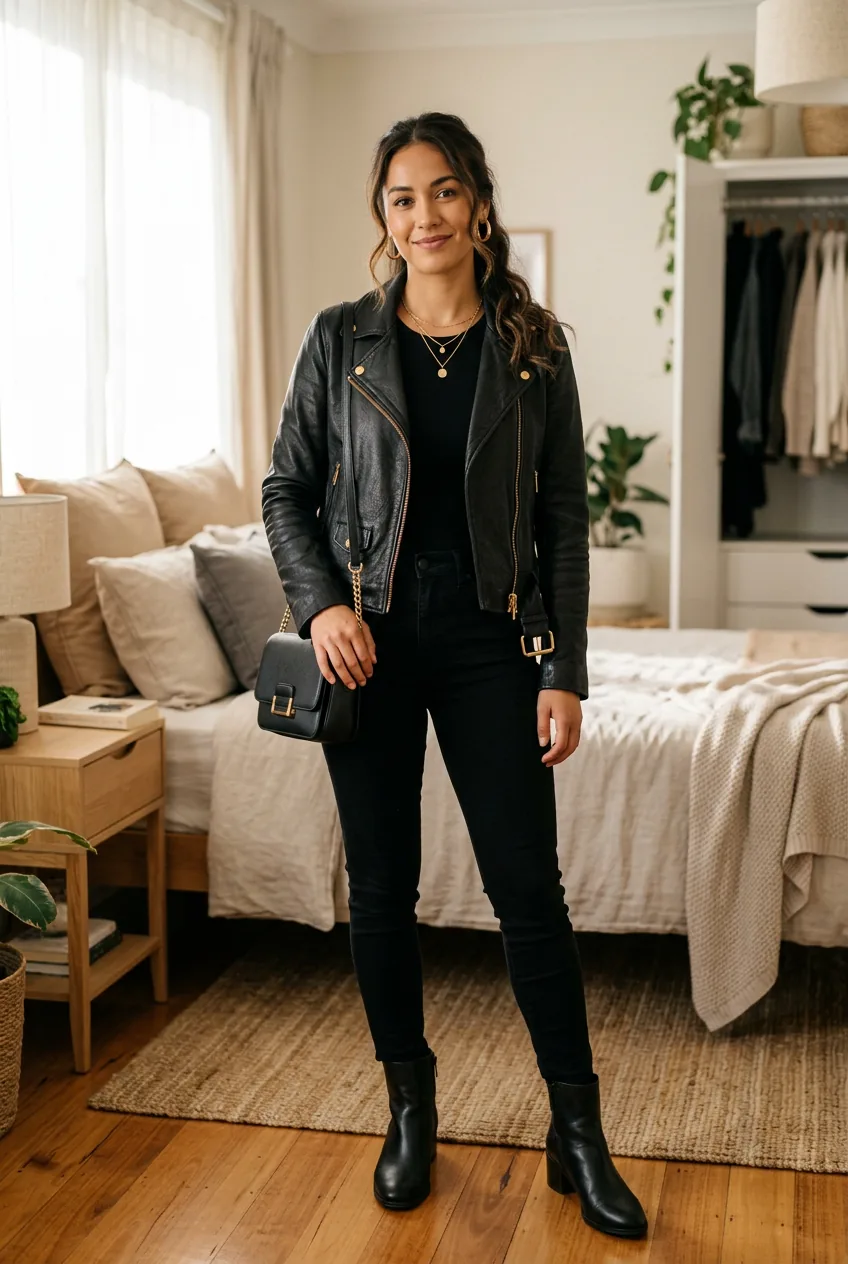
Shoes matter here too — they close the silhouette at the bottom the same way the jacket closes it at the top. Chunky ankle boots or lug-sole boots add edge and visual weight that anchors the whole thing. Pointed-toe flats or slim heeled boots elongate and dress it up. White sneakers give you that effortless street style energy. I’d avoid overly delicate shoes with a strong leather jacket unless you’re deliberately going for contrast — it can work, but you have to lean all the way into it, not just accidentally end up there.
If you love the process of building outfit formulas like this, the same logic applies when you work through something like the 6-step formula for a denim jacket outfit — proportions first, then outerwear, every time.
Phase 3: The Leather Jacket Goes On
Okay. This is the phase I genuinely look forward to every single time. You’ve built the base, you’ve set the proportions — now the jacket goes on and the whole thing locks in.
But how you wear the jacket matters as much as the jacket itself. There are really three options, and each sends a different message:
- Fully zipped or buttoned: Structured, purposeful, a little more serious. Great for cooler weather or when you want the jacket’s silhouette to be the focal point.
- Open, draped loosely: Effortless and relaxed. This is the most flattering option for most body types because it creates a long vertical line down the center of the body. My personal default.
- Pushed back off the shoulders: The «almost forgot I’m wearing a jacket» move. Incredibly stylish in editorial photos, surprisingly practical when you’re warm but don’t want to carry it. It does require a jacket that fits well enough to stay put.
Fit is everything at this stage. A leather jacket that pulls across the shoulders or gaps at the chest will look uncomfortable regardless of how good everything else is. When I’m trying on jackets, I do a simple arms-forward test — both arms extend in front of me, and if the back rides up or the shoulders bind, it’s a no. You want to feel like you can move freely. Look at the woman in the photo — she’s got the jacket sitting exactly on the shoulder seam, draped open, and you can see how the whole outfit just reads as a complete, intentional look from that moment it goes on.
Also worth mentioning: sleeve length. The jacket sleeve should hit right at your wrist or just slightly above it. If it’s swallowing your hands, that’s the wrong size. If it’s stopping mid-forearm, you need a longer sleeve (or a petite cut if you’re on the shorter side). This tiny detail is one of the things that separates a leather jacket outfit that looks polished from one that looks borrowed.
Getting jacket fit right is something a lot of people skip over, but I’d genuinely recommend reading up on it if you’ve always felt like jackets never quite work on you. Sometimes it’s just size, and that’s fixable.
A Stylist Shows How It All Comes Together
Phase 4: Accessories and Finishing
Here’s my rule for accessorizing any leather jacket outfit: because the jacket already has texture, structure, and personality, your accessories need to either complement it quietly or create deliberate contrast. What they cannot do is compete with it. A maximalist statement necklace under a leather jacket usually reads as noise, not style.
What actually works beautifully:
- Simple gold or silver hoops — classic, always right, especially medium-sized ones that you can see when the collar is up
- A delicate layered necklace — visible when the jacket is open and the base layer has a lower neckline
- A structured bag — a small crossbody or a boxy mini bag in black, tan, or a pop color works much better than an oversized tote here (save that for days when you’re not in a jacket with this much presence)
- A belt — if your jacket hits at the hip and you want to define the waist, a thin leather or chain belt worn over the jacket itself can look incredible and very 2026
- A scarf — loosely knotted or tucked into the collar of the jacket in an oversized vintage silk print plays off the jacket’s edge in the most satisfying way
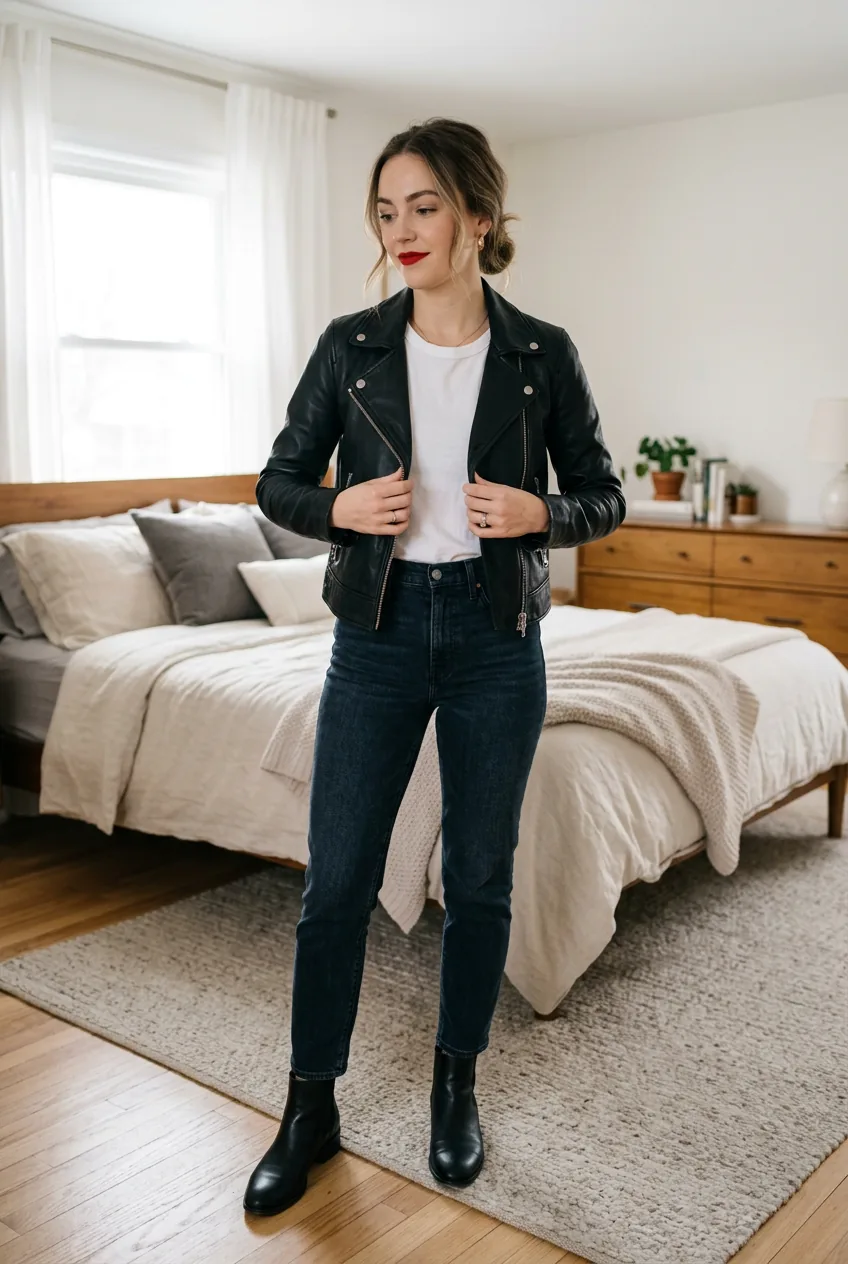
Now for finishing touches — and by that I mean hair and makeup, because they absolutely affect how the outfit reads. Leather jacket energy pairs naturally with lived-in hair: a messy low bun, a relaxed wave, effortless curtain bangs. It’s a little harder to pull off a very polished blowout with a street-style moto jacket without looking like you’re going somewhere very different from where your outfit suggests. That contrast can work intentionally — think the whole retro glamour outfits aesthetic where the polish is the point — but it needs to be deliberate.
As for makeup: I tend to go one of two directions. Either a bold lip (classic red or deep berry) with minimal eye, or a strong eye with a bare or nude lip. Both work. Both feel like they belong with leather. What doesn’t quite work, in my experience, is overly sweet or pastel-soft makeup with a tough jacket — unless, again, you’re leaning all the way into the contrast as an aesthetic choice. For inspiration on that kind of intentional mix of polish and edge, retro glamour outfits are a great place to look.
Phase 5: The Mirror Check
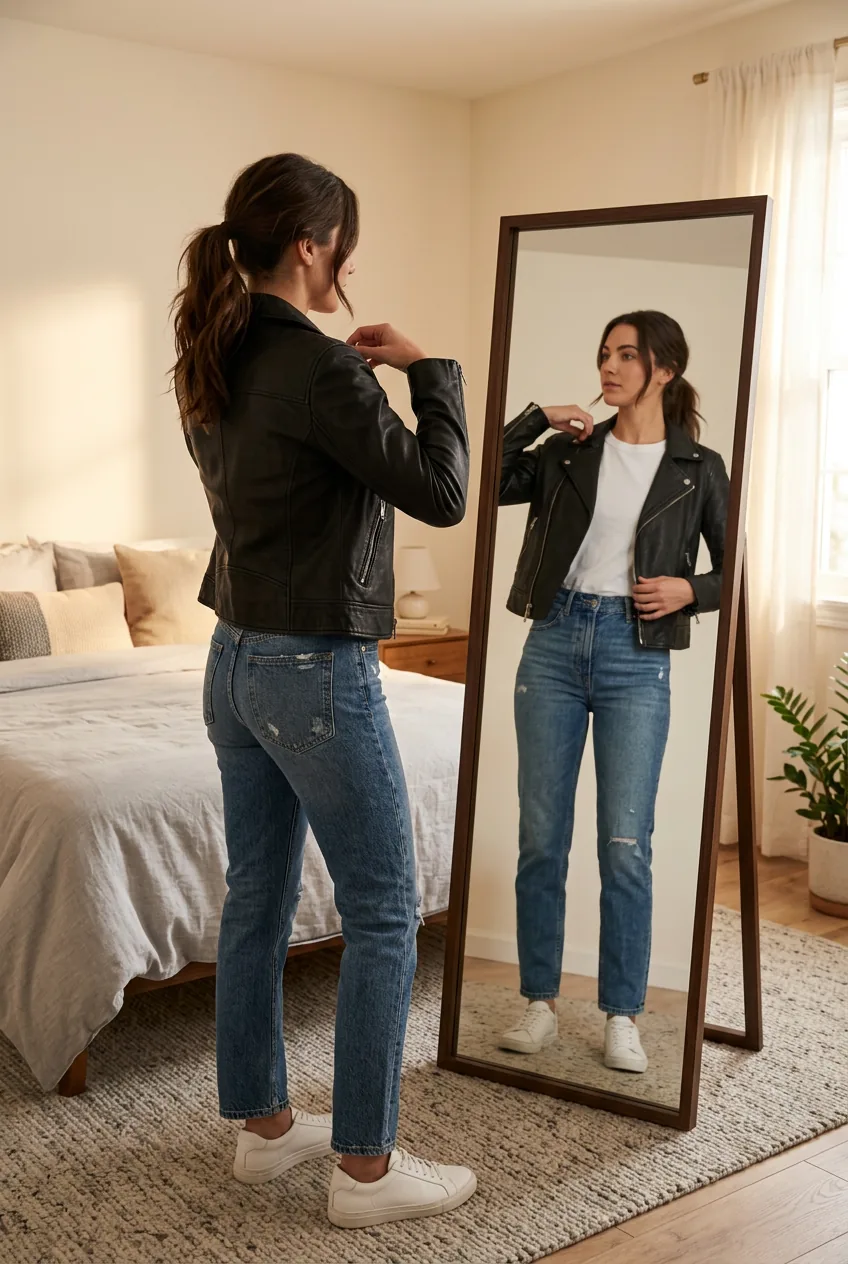
Every outfit I feel genuinely good in goes through a mirror check before I leave — and it’s not a vanity thing, it’s a calibration thing. You’re looking for specific things, not just a general vibe assessment.
First: the neckline. Is the base layer sitting cleanly inside or underneath the jacket collar? Is there any bunching at the collar or awkward fabric fold happening? Straighten it now — it’ll drive you crazy all day if you don’t.
Second: the waist. If you half-tucked your base layer, pull it so the tuck looks intentional rather than accidental. If you’re wearing a belt, center the buckle. The waist area is where the eye goes first, so it’s worth thirty extra seconds.
Third: the jacket itself. Shoulders sitting on the seam? Sleeves at the right length? If it’s open, is it symmetrically draped or has one side slipped further back than the other? A quick shrug and reseat fixes this instantly.
Fourth: the bottom half. Check the hem of your pants or skirt, the way your shoes relate to the hem. If you’re in jeans, is there any back-of-the-heel drag happening from walking? Roll them once if so — a cropped ankle silhouette almost always works better anyway with a leather jacket.
Finally: step back and look at the whole thing. Does anything feel visually louder than the jacket? If something is drawing your eye away from the overall silhouette — a very bright bag, a necklace that’s catching too much light, a pattern that’s competing — consider swapping it. The leather jacket should be the first thing someone notices. Everything else should support it.
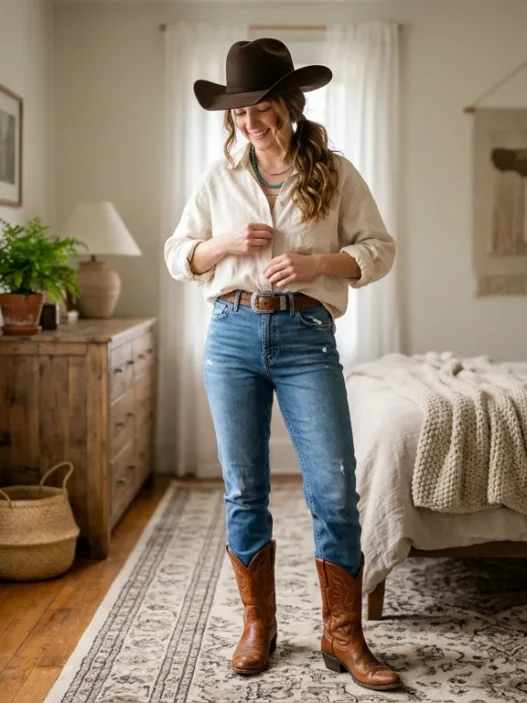
And honestly? If you’ve followed these phases, the answer to that last question is almost always no. The whole thing should just look right. That’s the goal of the process — not a perfect outfit, just one that looks like you meant it. The same approach works beautifully in other outfit-building contexts too. If you’re into the western-influenced look, trendy cowgirl outfits follow a similar phase logic — base, silhouette, outerwear or layer, accessories, final check. The bones of good getting-dressed are pretty universal.
Styling outerwear confidently — if you want to read more about how the same principles apply across different jacket styles, this is worth bookmarking.
Questions I Get About This
Can I wear a leather jacket in warm weather, or is it just a fall/winter piece?
Absolutely — a leather jacket in spring or even early summer over a light slip dress or linen-blend outfit is one of my favorite combinations. The key is treating it like an accessory rather than a warmth layer: drape it open or even over your shoulders instead of wearing it zipped. It adds structure without adding heat, and the contrast with something floaty and feminine is genuinely stunning.
Does the color of my leather jacket really change how I build the outfit?
Yes, more than most people realize. Black leather is the easiest because it functions as a true neutral and you can pair it with literally any palette. Brown or tan leather has a warm undertone that naturally calls for earthy, warm colors — cream, camel, rust, olive. If you pair a warm brown jacket with cool-toned grey or icy blue, the jacket tends to look disconnected from the rest of the outfit. It’s not a hard rule, but it’s one I always come back to.
What’s the best bottom to wear with a cropped moto jacket if I’m petite?
High-waisted anything is your best friend here — it creates the illusion of longer legs and prevents the cropped hem from visually cutting your body in half. My personal favorite for petite builds is high-waisted straight-leg jeans with ankle boots or pointed flats, because the combination elongates from waist to toe in one clean line. Avoid low-rise or mid-rise anything with a cropped jacket if leg-lengthening is your goal.
How do I keep a leather jacket from making my shoulders look wide?
Wear it open rather than zipped — the open vertical line down the center of the chest actually draws the eye inward and downward, which minimizes the appearance of width at the shoulders. Also, avoid jackets with heavy epaulettes or very structured shoulder padding if this is a concern. A softer, more relaxed leather or vegan leather will drape more naturally over the shoulder rather than building it out. And a V-neckline on your base layer reinforces that vertical line beautifully.
Is vegan leather a good substitute, or does it look obviously fake?
Modern vegan leather has come a long way — some of it is genuinely indistinguishable from the real thing in photos and in person. The quality varies enormously by brand, though. What to look for: a matte or semi-matte finish rather than a very shiny surface (which reads as cheap), weight that feels substantial rather than papery, and stitching details that look intentional. I own both real and vegan leather jackets and rotate them freely depending on the look I’m going for.
The first time I ran through all five of these phases deliberately — instead of just pulling things off hangers and hoping — I walked out the door in a leather jacket outfit that actually stopped a friend mid-sentence to ask what I was wearing. Which, honestly, is the only review that matters. The process takes maybe ten extra minutes the first few times. After that, it becomes muscle memory. You’ll find yourself doing the mirror check automatically, building the silhouette before even thinking about it. That’s when getting dressed stops feeling like a puzzle and starts feeling like the best part of the morning.